

You’ve tried counting sheep. You’ve downloaded every white-noise app. You’ve even tried chamomile tea at 10 PM. But sleep still escapes you. Here’s what nobody told you: the missing piece might not be in your bedroom at all — it might be in a 30-minute yoga practice you do lying completely still.
- What Is Yoga Nidra? (It’s Not What You Think)
- The Neuroscience Behind Yoga Nidra and Sleep
- Yoga Nidra vs. Regular Meditation for Sleep: What’s the Difference?
- Step-by-Step Yoga Nidra Practice for Sleep Tonight
- How Often Should You Practice Yoga Nidra for Sleep?
- Common Mistakes to Avoid
- Who Should Try Yoga Nidra for Sleep?
- Final Thoughts: The Sleep You’ve Been Missing
Yoga Nidra for sleep is not just another wellness trend. It is a 3,000-year-old yogic technique that has now been validated by modern neuroscience. When practised consistently, it can reduce the time it takes you to fall asleep, deepen the quality of your rest, and even help you process emotional stress that keeps your nervous system buzzing at night.
In this complete guide, you will learn exactly what Yoga Nidra is, why it works for sleep, how to practise it tonight, and what science says about its benefits — so you can finally wake up tomorrow feeling genuinely rested.
What Is Yoga Nidra? (It’s Not What You Think)
Yoga Nidra translates from Sanskrit as ‘yogic sleep.’ But that’s a little misleading. You don’t actually fall asleep during the practice. Instead, you enter a state of consciousness that sits in the doorway between waking and sleeping — a hypnagogic state that scientists now classify as a theta brainwave state.

In everyday life, your brain cycles through four main states: Beta (active thinking), Alpha (relaxed), Theta (drowsy, creative), and Delta (deep sleep). Yoga Nidra for sleep works by intentionally guiding your brain from Beta all the way down to Theta — and sometimes even Delta — while keeping a thin thread of awareness alive.
This is different from regular meditation, where you typically stay in Alpha. And it is very different from sleep, where you lose conscious awareness entirely. The theta state accessed during Yoga Nidra is considered one of the most healing states the human brain can enter, associated with memory consolidation, emotional processing, and cellular repair.
The Neuroscience Behind Yoga Nidra and Sleep
A landmark study published in the Applied Psychophysiology and Biofeedback journal found that regular Yoga Nidra practice significantly reduced anxiety and improved sleep quality in participants within just four weeks. But how does it actually work biologically?
1. It Activates the Parasympathetic Nervous System
Most people struggling with sleep are stuck in a state of sympathetic dominance — the ‘fight or flight’ mode. Your cortisol stays elevated, your heart rate doesn’t drop, and your mind keeps looping through to-do lists. Yoga Nidra deliberately activates the parasympathetic nervous system (your ‘rest and digest’ mode) through body scanning, breath awareness, and visualisation. Your heart rate drops. Your muscles release tension. Your cortisol falls. Sleep becomes physiologically possible.
2. It Lowers Cortisol and Raises Melatonin
Research from the International Journal of Yoga has shown that Yoga Nidra reduces salivary cortisol levels measurably after a single session. Lower cortisol allows your pineal gland to release more melatonin — your body’s natural sleep hormone. This is why so many people who practice Yoga Nidra for sleep report feeling naturally sleepy by the end of a session, without relying on medication or supplements.
3. It Processes Emotional Backlog
Unprocessed emotions are one of the most under-discussed causes of poor sleep. Yoga Nidra works directly with the subconscious layer of the mind through a technique called Sankalpa (intention setting) and imagery rotation, helping the brain process unresolved emotional material that would otherwise keep you awake at 3 AM.
Yoga Nidra vs. Regular Meditation for Sleep: What’s the Difference?
Many people try regular mindfulness meditation for sleep and find it helpful but not quite enough. Here is why Yoga Nidra goes deeper:
- Mindfulness meditation: Keeps you in Alpha brainwaves; great for stress reduction but doesn’t always induce sleep
- Body scan meditation: Similar to Yoga Nidra but less systematic; works on muscle tension but not the full subconscious layer
- Yoga Nidra: Takes you from Alpha through Theta into the edge of Delta, accessing the deepest layers of rest and healing
- Sleep: Full unconsciousness; no control over what the mind processes
Think of Yoga Nidra as a bridge between meditation and sleep. It gives your body the physiological rest of sleep while allowing your mind to remain in a guided, healing state.
Step-by-Step Yoga Nidra Practice for Sleep Tonight
You don’t need any equipment, prior yoga experience, or a special room. All you need is 25–35 minutes and a quiet space where you can lie down undisturbed.
Step 1: Prepare Your Space (2 minutes)
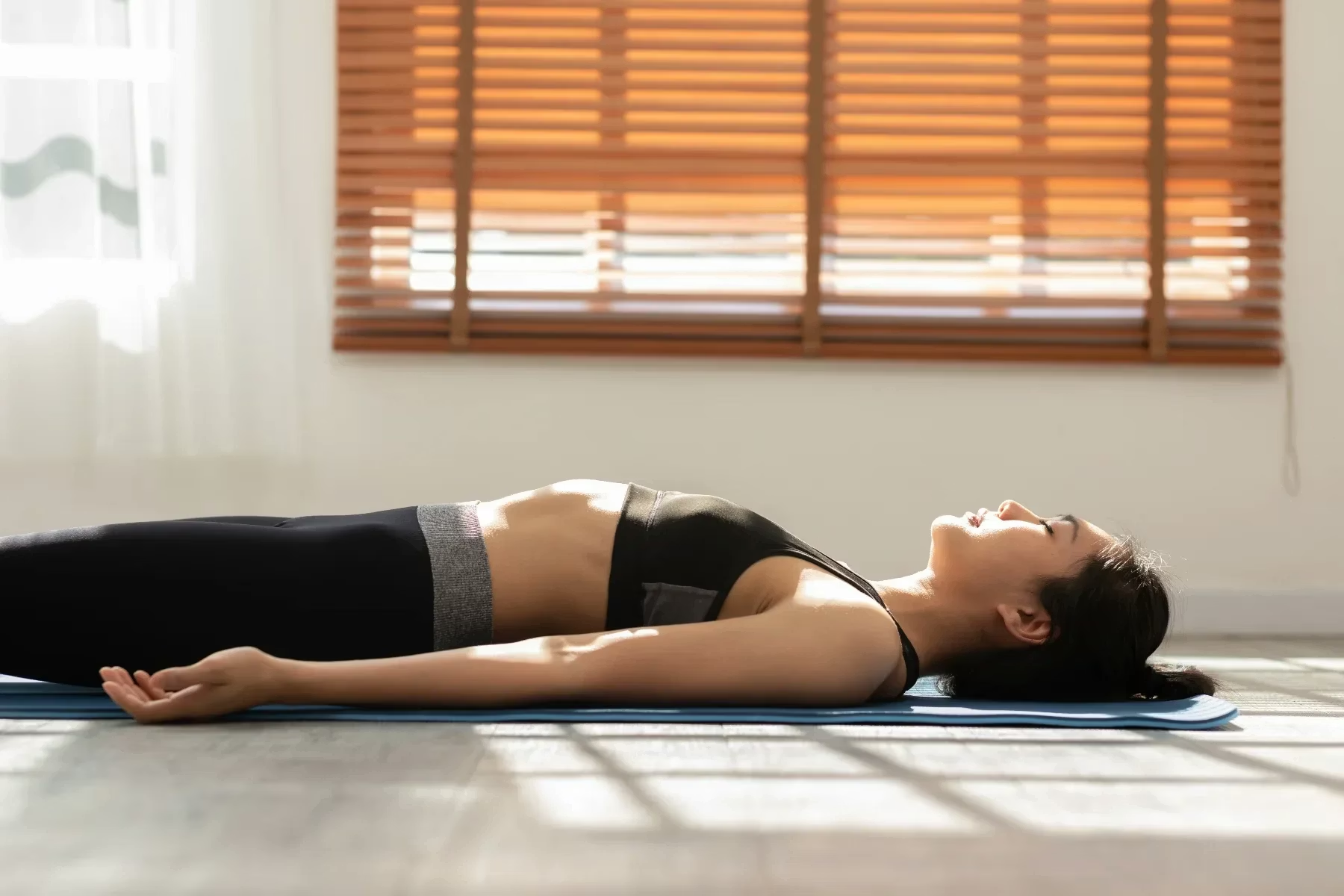
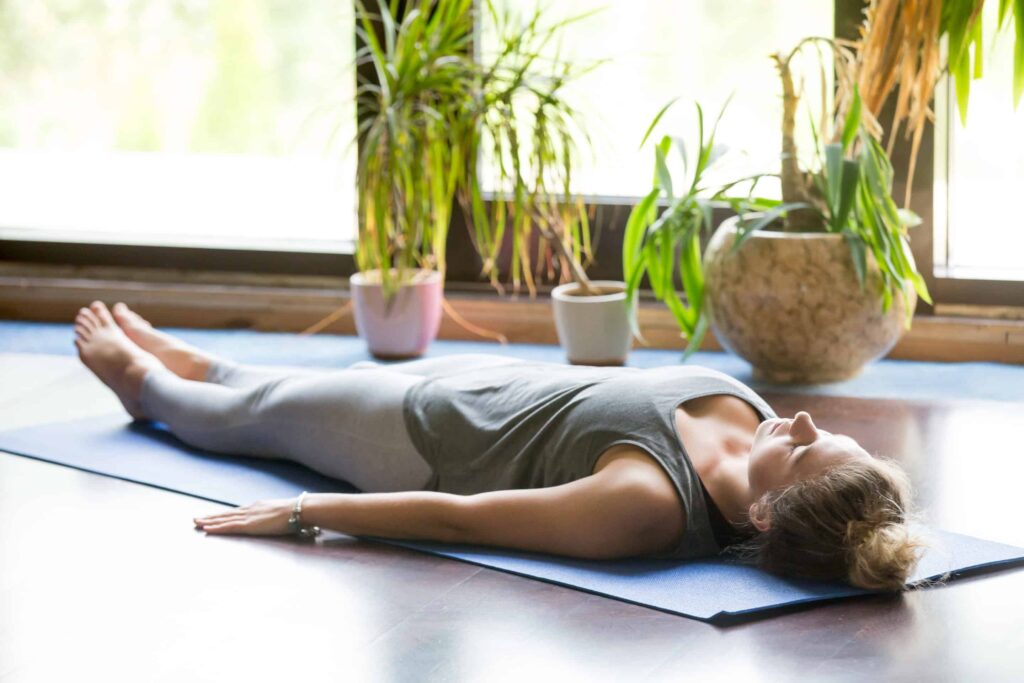
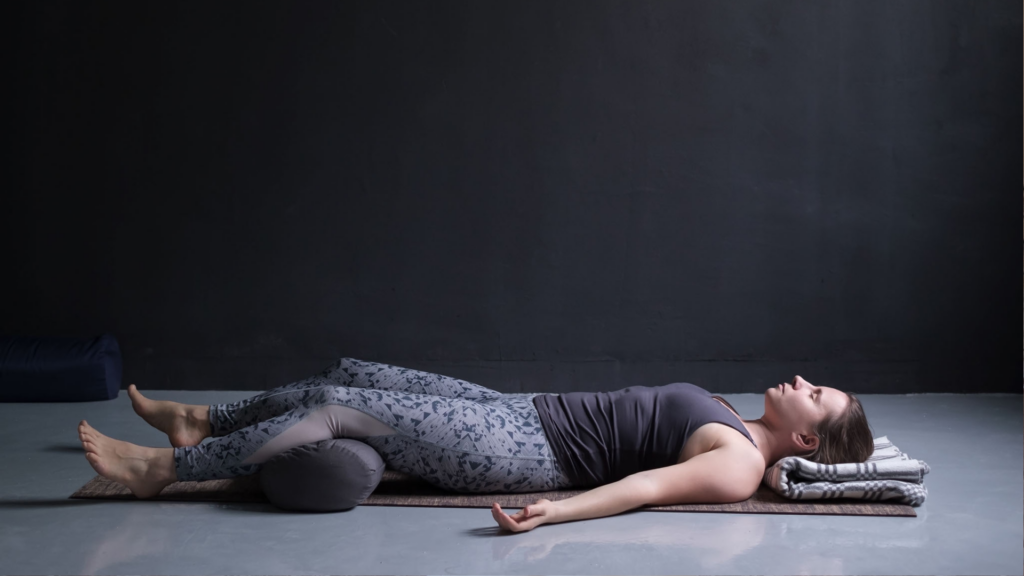
Lie down in Savasana (flat on your back) on your bed or a yoga mat. Place a thin pillow under your head. Cover yourself lightly with a blanket — your body temperature will drop slightly during the practice. Dim the lights or use an eye pillow. Turn off notifications. Let someone at home know you are not to be disturbed.
Step 2: Set Your Sankalpa (Intention) — 1 minute
Before you sink into deeper states, plant a seed in your mind. A Sankalpa is a short, positive, present-tense resolve. For sleep, it might be: ‘I fall asleep easily and wake up refreshed’ or ‘My body and mind heal deeply every night.’ Say it mentally three times with feeling. Don’t overthink it. Let it drop into your awareness like a stone into still water.
Step 3: Rotation of Consciousness — 10 minutes
This is the core of Yoga Nidra for sleep. You will mentally move your awareness through every part of your body in a specific sequence. The key is speed — move quickly, don’t linger too long on any one part. Right thumb, right index finger, middle finger, ring finger, little finger, back of the right hand, palm, wrist, forearm, elbow, upper arm, shoulder, armpit, right side of the chest, right side of the waist, right hip, right thigh, kneecap, calf, ankle, heel, sole of the foot, right big toe, second toe, third toe, fourth toe, fifth toe. Now repeat for the left side. Then move to the back of the body, the face, the top of the skull, and finally become aware of your whole body at once.
Step 4: Breath Awareness — 5 minutes
Now turn your attention to your natural breath. Don’t control it. Simply observe. Count each exhale backwards from 27 to 1. If you lose count, start again from 27. This simple technique engages just enough of your conscious mind to stop the thought spiral, while your body continues to sink deeper into rest. Many people fall asleep during this phase — and that is completely fine.
Step 5: Visualisation — 8 minutes
Your guide (or your own mental narration) will now present a series of images rapidly. A golden sunset. A cool mountain lake. A flickering candle. A vast open sky. A sleeping child. Your childhood bedroom. These are not random — they work by stimulating both hemispheres of the brain simultaneously, which rapidly creates the conditions for deep sleep onset. If you are practising solo without a recording, simply allow any imagery to arise naturally and watch it like a movie, without attachment.
Step 6: Return to Sankalpa and Gentle Awakening — 2 minutes
If you are using Yoga Nidra as a bedtime practice, you don’t need this step — simply allow yourself to drift into full sleep. If you are practising earlier in the evening, gently bring your Sankalpa back to mind three times. Then slowly deepen your breath, wiggle your fingers and toes, stretch your arms overhead, and roll to one side before sitting up. Don’t rush. Give yourself 2–3 minutes to re-enter waking consciousness.
How Often Should You Practice Yoga Nidra for Sleep?
For chronic sleep issues, daily practice for at least 21 days is recommended. Research suggests that changes in the autonomic nervous system — the key mechanism behind Yoga Nidra’s sleep benefits — become semi-permanent after consistent practice over three to four weeks.
For maintenance and ongoing sleep quality, three to four sessions per week is excellent. Even one session per week is far better than nothing. The key is consistency, not perfection.
Common Mistakes to Avoid
- Trying too hard to stay awake: It’s okay to fall asleep. The subconscious mind still receives the practice even when you drift off.
- Skipping the Sankalpa: This is the most underrated part of the practice. The theta state makes the mind hyper-receptive to suggestion — use it wisely.
- Practising right after a heavy meal: Wait at least 90 minutes. Digestion keeps the body in a slightly aroused state.
- Using a phone screen: If using a guided audio, put your phone face down or use a sleep-specific app setting to avoid blue light exposure.
Who Should Try Yoga Nidra for Sleep?
Yoga Nidra is beneficial for virtually anyone, but it is particularly powerful for:
- People with insomnia or chronic sleep disruption
- Anxiety and stress sufferers whose minds won’t quiet at night
- Shift workers or frequent travellers dealing with disrupted circadian rhythms
- Menopausal women experiencing sleep disruption due to hormonal changes
- Athletes needing deeper recovery sleep for performance
- Anyone who has struggled to maintain a regular meditation practice
Because Yoga Nidra requires no physical movement and no prior meditation experience, it has one of the lowest barriers to entry of any wellness practice. You simply lie down and listen.
Final Thoughts: The Sleep You’ve Been Missing
Quality sleep is not a luxury — it is the foundation of every other aspect of your health, mood, and performance. Yet millions of people treat poor sleep as an inevitable part of modern life, reaching for sleeping pills or caffeine to compensate.
Yoga Nidra for sleep offers a third path: a natural, deeply studied, and genuinely effective way to retrain your nervous system for rest. It costs nothing. It takes less than 30 minutes. And its benefits compound over time — meaning the more consistently you practice, the more effortlessly you sleep.
Start tonight. Lie down. Close your eyes. And let your body remember how to rest the way it was always designed to.
Explore more yoga and meditation guides at YogaSniff.com