

Anxiety doesn’t just live in your head. It lives in the tension locked in your shoulders, the tightness in your chest, the shallow breaths you’ve been taking for years without realising it. This is not a metaphor — it is neuroscience. And it is why traditional talk therapy, while valuable, often isn’t enough on its own to truly heal anxiety. The body needs to be part of the conversation.
- What Is Somatic Yoga? Understanding the Body-Mind Connection
- How Anxiety Gets Stored in the Body
- The 7 Key Principles of Somatic Yoga for Anxiety Relief
- A Complete 30-Minute Somatic Yoga Practice for Anxiety
- What to Expect After Your First Session
- Combining Somatic Yoga with Other Anxiety Treatments
- Start Where You Are
Somatic yoga for anxiety is a body-first approach that combines the ancient wisdom of yoga with modern somatic therapy principles to release anxiety that has become physically stored in your tissues, fascia, and nervous system. In this guide, you’ll discover what somatic yoga is, the science behind why it works, and a complete practice you can begin using today.
What Is Somatic Yoga? Understanding the Body-Mind Connection
The word ‘somatic’ comes from the Greek ‘soma,’ meaning body. Somatic therapy is a clinical approach developed by pioneers like Dr. Peter Levine (creator of Somatic Experiencing) and Bessel van der Kolk (author of The Body Keeps the Score) that recognises the body as a primary holder of emotional experience — especially trauma and chronic anxiety.
Somatic yoga blends this therapeutic framework with yoga postures, breathwork, and mindful movement. Rather than practising yoga poses for their physical benefits alone, somatic yoga asks you to practise with heightened interoception — internal body awareness — noticing where you hold tension, where your body contracts in response to stress, and where breath is blocked.

The result is not just a yoga practice, but a full-body anxiety release system.
How Anxiety Gets Stored in the Body
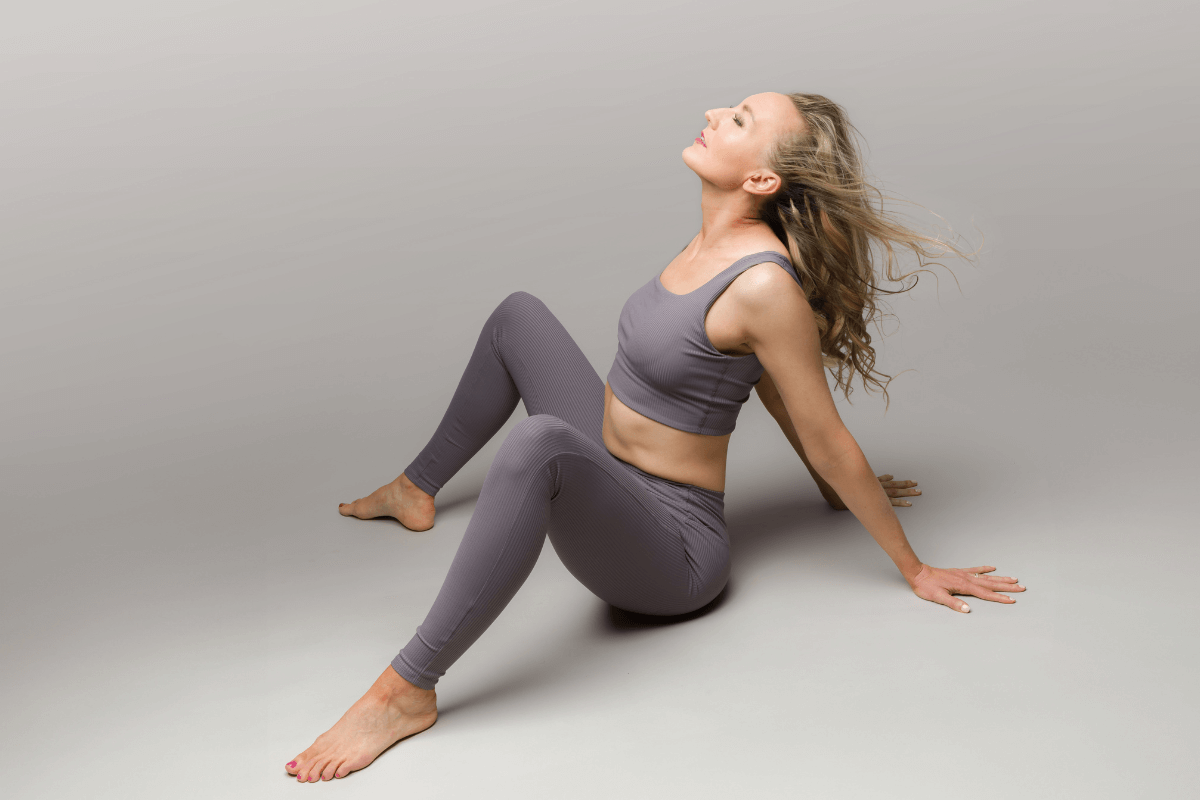
When you experience a stressful event, your brain activates the hypothalamic-pituitary-adrenal (HPA) axis, flooding your body with cortisol and adrenaline. Your muscles contract to prepare for fight or flight. Your breath shortens. Your jaw clenches. Your stomach tightens.

In a healthy stress response, once the threat passes, your nervous system discharges this arousal — often through physical movement, trembling, or deep breathing — and returns to baseline. But in modern life, most of us suppress this discharge. We sit still. We push through. We tell ourselves to ‘calm down’ or ‘be rational.’
Over time, this suppressed arousal accumulates in the body. Muscles stay chronically contracted. Fascia — the connective tissue that wraps all your muscles — becomes rigid and restricted. The nervous system gets stuck in a low-grade state of alert. This is the physical substrate of chronic anxiety: a body perpetually braced for a threat that’s no longer there.
The 7 Key Principles of Somatic Yoga for Anxiety Relief
1. Pendulation
Rather than forcing yourself to stay in uncomfortable sensations, somatic yoga uses pendulation — gently moving your attention between areas of tension and areas of ease within the body. This teaches the nervous system that it can safely experience intensity without becoming overwhelmed.
2. Titration
Titration means working with small, manageable doses of sensation rather than diving into the deep end. In somatic yoga for anxiety, you slowly approach the edges of your comfort zone — a tight hamstring, a constricted chest — without overwhelming your system.
3. Grounding
Feeling your feet on the floor, your hands on your mat, your seat in a chair — grounding practices activate the ventral vagal pathway (the ‘safe and social’ branch of the nervous system) and provide an anchor during anxiety activation.
4. Interoceptive Awareness
Interoception is your ability to sense internal body signals. Research shows that people with anxiety often have distorted interoception — they either overreact to bodily sensations (catastrophising a racing heart) or under-react (being disconnected from physical cues). Somatic yoga systematically rebuilds healthy interoceptive awareness.
5. Discharge and Release
Somatic yoga creates safe conditions for the body to discharge stored tension — through trembling, sighing, spontaneous yawning, heat, tingling, or emotional release. These are not signs that something is wrong; they are signs that your nervous system is finally completing the stress cycle it started months or years ago.
6. Resourcing
Before working with areas of tension, somatic yoga identifies ‘resource’ areas — parts of the body that feel safe, warm, or comfortable. You return to these resources regularly to avoid re-traumatisation and build a felt sense of safety.
7. Integration
After each somatic yoga session, time is devoted to integration — lying still, doing nothing, simply letting the nervous system absorb and consolidate the changes that have occurred. This rest phase is not optional; it is where the healing actually happens.
A Complete 30-Minute Somatic Yoga Practice for Anxiety
Part 1: Grounding and Arrival (5 minutes)
Come to stand or sit comfortably. Feel the weight of your body against the floor or chair. Take three long, slow exhales — longer than your inhales. Notice: where do you feel your body most clearly right now? Feet? Hands? The seat of your pelvis? Simply notice without trying to change anything. Spend two minutes gently swaying side to side, finding your centre. Notice how the movement feels different on either side.
Part 2: Neck and Jaw Release (5 minutes)
Anxiety frequently accumulates in the jaw, neck, and throat. Slowly drop your chin to your chest. Hold for six breaths. Roll your right ear toward your right shoulder. Hold for six breaths. Return to centre. Now gently open your mouth as wide as is comfortable, hold for three seconds, then let it go. Notice any tingling or warmth in your face — these are signs of release. Repeat four times.
Part 3: Hip Flexor Release — Low Lunge with Breath (8 minutes)
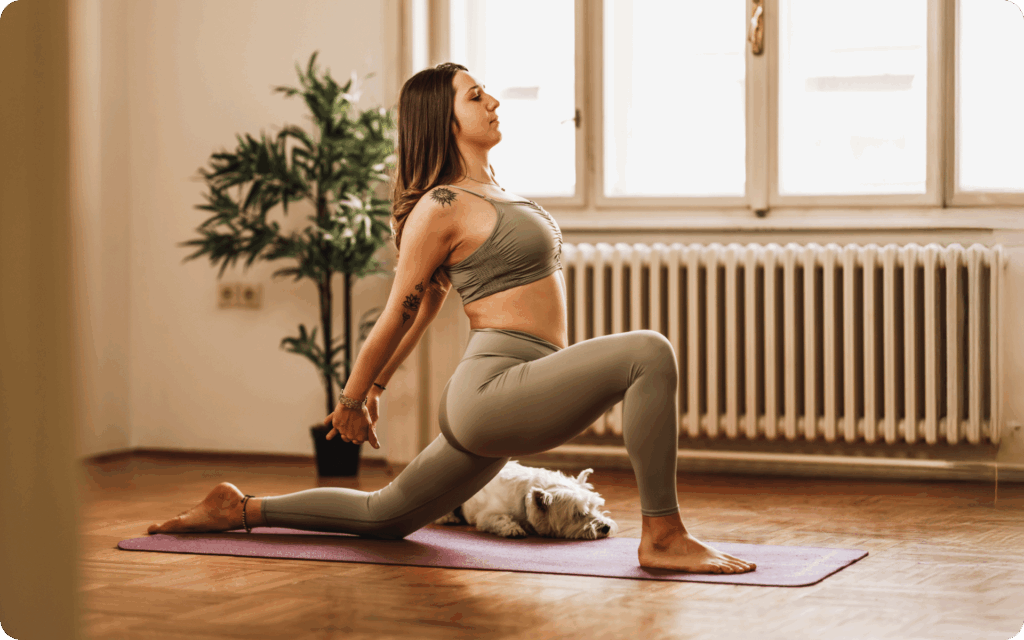
Come into a low lunge with your right foot forward. Place your back knee on the floor. Settle into the pose gently — you are not trying to get deeper, you are simply staying. Now bring your attention to the psoas muscle, which runs from your lower spine through your hip flexors to your thigh. This muscle is called the ‘fight-or-flight muscle’ — it contracts in response to every threat, real or perceived. With each exhale, invite (don’t force) a softening here. Stay for 12 slow breaths. Then switch sides.
Part 4: Bound Angle — Heart and Groin Opening (5 minutes)
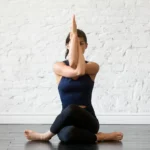
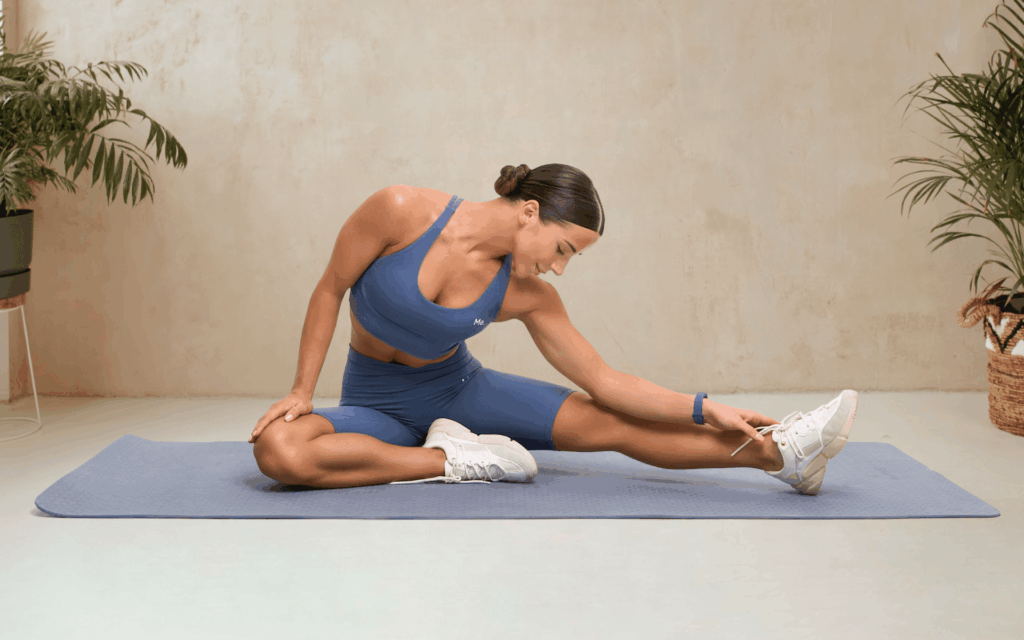
Sit with the soles of your feet together, knees falling out to the sides. Fold gently forward only as far as is comfortable. Your goal is not to touch your forehead to your feet — your goal is to feel the inner thighs and groin (where anxiety tension commonly accumulates) and breathe into them. If you notice emotional discomfort, use pendulation: briefly shift your attention to a part of the body that feels okay, breathe there for a moment, then gently return.
Part 5: Supported Fish — Chest and Throat Opening (5 minutes)
Lie on your back with a rolled blanket or block beneath your upper back, just between your shoulder blades. Let your arms fall open, palms face up. Your chest will open naturally. Breathe fully into your front body. Many anxiety sufferers have collapsed chest postures — the result of years of protective bracing. This pose gently reverses that pattern and stimulates the vagus nerve, activating your parasympathetic nervous system.
Part 6: Integration in Savasana (7 minutes)
Remove the prop. Lie fully flat. Allow your body to do whatever it needs — twitch, sigh, make small adjustments. Don’t intervene. Simply witness. This is integration time. Your nervous system is consolidating new patterns of safety and release. Stay here for at least seven minutes. When you are ready, take three deep breaths, roll to your side, and pause there for a minute before sitting up.
What to Expect After Your First Session
After your first somatic yoga session for anxiety, you may experience: a sense of deep physical heaviness (your muscles finally releasing chronic bracing); unexpected emotion — tears are common and completely normal; temporary increased sensitivity; a sense of spaciousness in the chest and belly; or simply deep tiredness and the urge to sleep.
All of these are healthy responses. Your body has been waiting to do this work. After consistent practice of two to three sessions per week, most people report a measurable reduction in generalised anxiety within three to six weeks.
Combining Somatic Yoga with Other Anxiety Treatments
Somatic yoga is not a replacement for professional mental health care. If you are working with anxiety, depression, PTSD, or trauma, please continue working with a qualified therapist or mental health professional. Somatic yoga works beautifully as a complement to:
- Cognitive Behavioural Therapy (CBT)
- EMDR (Eye Movement Desensitisation and Reprocessing)
- Somatic Experiencing therapy with a trained SE practitioner
- Medication management for anxiety disorders
Start Where You Are
You do not need to have had a big ‘T’ trauma to benefit from somatic yoga. Chronic low-grade stress — the kind that accumulates over years of overwork, people-pleasing, financial pressure, and relationship difficulties — creates the same physiological patterns in the body as acute trauma. Somatic yoga for anxiety addresses both.
Your body already knows how to heal. Somatic yoga simply gives it permission.
Explore more yoga and meditation guides at YogaSniff.com