


Running is one of the most natural human movements — but the way most people run in 2026 is anything but natural. Shoes that alter gait mechanics, hard pavement that sends relentless impact up the kinetic chain, sedentary desk jobs that leave the hip flexors permanently shortened before the run even begins, and post-run routines that consist of collapsing on the sofa — all of these contribute to the staggering injury rate in recreational running. Studies consistently find that between 37 and 56 percent of regular runners sustain an injury in any given year.
Yoga for runners is not a trend. It is one of the most evidence-supported tools available for reducing injury risk, accelerating recovery, improving running economy (efficiency), and extending the longevity of a running career. The world’s best distance runners — including many marathon world record holders — incorporate yoga or yoga-based stretching as a non-negotiable part of their training.
This guide covers the specific anatomical vulnerabilities of runners, the yoga poses that most directly address them, a complete 30-minute post-run yoga routine, and a shorter 10-minute pre-run activation sequence.
The Runner’s Body: Understanding Your Specific Vulnerabilities

Running is a repetitive, single-plane activity. Unlike multi-directional sports, it loads the body in the same movement pattern hundreds of thousands of times per year. This creates predictable patterns of tightness, weakness, and overuse that yoga for runners specifically targets.
The Five Key Tightness Zones in Runners
- Hip flexors (especially psoas and iliacus): Chronically shortened by both sitting and the running stride. Tight hip flexors reduce stride length, increase anterior pelvic tilt, and are directly associated with lower back pain and hamstring injuries.
- Hamstrings: Repeatedly loaded eccentrically during the running stride. Tight hamstrings increase injury risk and reduce running economy.
- Calves and Achilles tendon: The primary propulsion muscles in running. Chronically tight calves are associated with plantar fasciitis, Achilles tendinopathy, and shin splints.
- IT band and outer hip: The iliotibial band is not actually a muscle and cannot be stretched in the traditional sense, but releasing the hip abductors and TFL (tensor fasciae latae) that connect to it dramatically reduces IT band syndrome.
- Thoracic spine and chest: Running with rounded shoulders and a stiff thoracic spine reduces arm drive efficiency and restricts breathing capacity.
The Three Key Weakness Patterns in Runners
- Glute medius weakness: Responsible for hip stability during single-leg stance. Weakness causes the characteristic ‘Trendelenburg drop’ (hip dropping on the non-stance side) which stresses the IT band, knee, and lower back.
- Deep core weakness: The transverse abdominis provides spinal stability during the running gait. Weakness leads to energy leakage through the torso and increased injury risk.
- Foot intrinsic muscle weakness: Supportive footwear has weakened the small muscles of the foot that should provide dynamic arch support, contributing to plantar fasciitis and stress fractures.
The 10-Minute Pre-Run Yoga Activation Sequence
Note: this pre-run sequence uses dynamic (moving) stretches rather than static holds, which are now known to reduce power output when performed before exercise. Save the static holds for the post-run sequence.
1. Sun Salutation — 3 rounds (3 minutes)
A slow Sun Salutation warms up the entire body through its full range of motion, activates the spinal stabilisers, opens the hip flexors dynamically in Low Lunge, and wakes up the hamstrings in Forward Fold. Move in coordination with your breath: inhale to extend, exhale to fold.

2. Dynamic Pigeon Pose — 45 seconds each side (90 seconds)
From a low lunge, bring your front shin toward parallel and pulse gently: forward (deepening the hip stretch) and back (reducing it). This dynamic movement activates the hip external rotators and glute medius before asking them to work in the run.
3. Walking Lunges with Torso Rotation — 60 seconds
Step into a lunge and rotate your torso toward the front leg. Step forward into the next lunge and rotate the other way. This activates the hip flexors, glutes, and thoracic rotation simultaneously — all essential for running mechanics.
4. Standing Hip Circles — 30 seconds each side
Stand on one leg and draw large circles with the raised knee — forward, out, back, and in. This activates the hip stabilisers (particularly glute medius) and improves joint lubrication before impact loading.
5. Calf Raises and Toe Spreads — 60 seconds
Stand with feet hip-width apart. Rise onto your toes 10 times slowly, then 10 times quickly. Then sit in a squat and actively spread and scrunch your toes. This activates the calf-Achilles complex and foot intrinsic muscles — the first structures to absorb impact when running.

The Complete 30-Minute Post-Run Yoga Routine for Runners
This is where the real recovery magic happens. After a run, your muscles are warm, blood flow is elevated, and the connective tissue is more pliable than at any other time of day. This is the optimal window for longer static holds. Do not skip this routine — it is the difference between runners who stay healthy for decades and those who cycle through injury after injury.
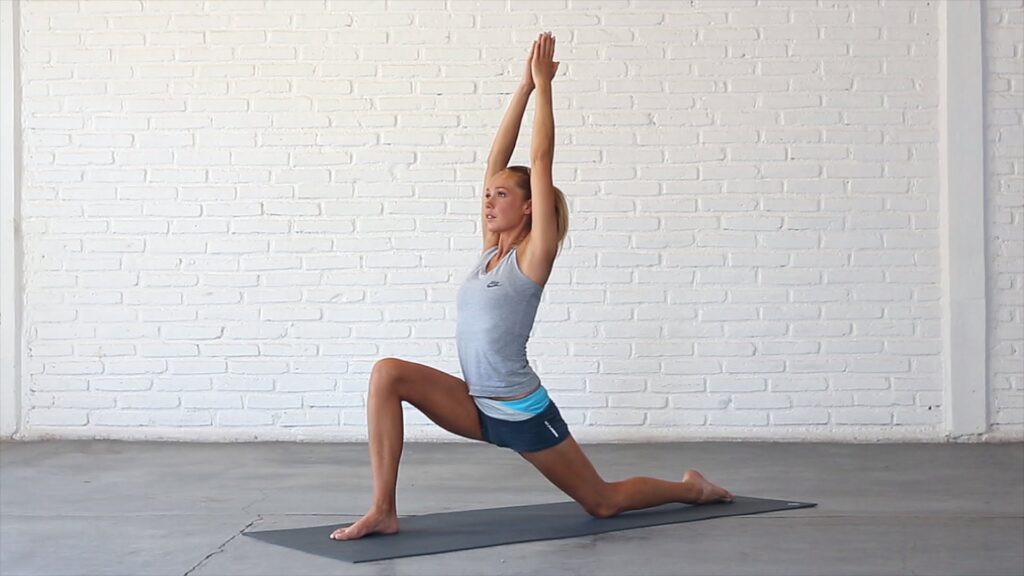
1. Low Lunge — Anjaneyasana — 2 minutes each side
Your first priority after a run is the hip flexors, which have been working hard and will tighten rapidly as you cool down. Come into a low lunge and sink your hips low and forward. Keep the back knee on the floor. Reach your arms overhead to add a full anterior body stretch. Breathe into the front of the hip and inner thigh with every exhale. After 90 seconds, add a gentle backbend by lifting the chest and looking up — this deepens the psoas stretch and opens the chest simultaneously.
2. Pyramid Pose — Parsvottanasana — 90 seconds each side
From standing, step one foot back about 90 cm. Square your hips forward and fold over your front leg, keeping both legs straight. This is the most effective hamstring stretch for runners because it loads the hamstring in the exact lengthened position it occupies during the running stride — far more specific than a seated hamstring stretch.
3. Sleeping Swan — Yin Pigeon — 3 minutes each side
From all fours, bring your right knee behind your right wrist, shin angled across the mat. Lower your torso forward. This is the single most effective pose for releasing the piriformis, outer hip, and IT band attachment points — the muscles most associated with IT band syndrome and runner’s knee. Hold for 3 full minutes each side and breathe into the deep sensation.
4. Supine Figure Four — 2 minutes each side
Lie on your back. Cross your right ankle over your left thigh just above the knee. Flex your right foot. Either stay here or draw the left knee toward your chest to intensify. This is a more accessible variation of Pigeon that targets the same outer hip structures and is ideal for runners who are too tired for the prone position after a long run.
5. Downward Dog with Calf Pedalling — 90 seconds
Come into Downward Facing Dog. Alternate pressing each heel toward the floor with a gentle, rhythmic pedalling motion. This systematically lengthens the calf, soleus, and Achilles tendon of each leg. Then hold with both heels reaching down for 30 seconds. Essential after every run for preventing plantar fasciitis and Achilles tendinopathy.
6. Seated Forward Fold — Paschimottanasana — 3 minutes
Sit with both legs extended. Fold forward, reaching for your feet, ankles, or shins. Round the spine gently rather than forcing a flat back. Hold for 3 full minutes. The extended hold accesses the fascial layer around the hamstrings — critical for runners, whose hamstrings experience sustained fascial loading far greater than their muscles alone.
7. Supine Spinal Twist — 2 minutes each side
Lie on your back and guide one knee across your body into a twist. Running is an asymmetrical activity at the micro level — most runners have subtle left-right imbalances that accumulate over many miles. This twist releases accumulated spinal tension and resets the sacroiliac joint, which is a frequent source of dull aching pain in regular runners.
8. Legs Up the Wall — 5 minutes
Finish every post-run yoga session here. Lie with your legs extended up a wall for 5 minutes. This simple inversion dramatically accelerates the clearance of metabolic waste products from the leg muscles by facilitating venous return against gravity, reduces inflammation in the feet and lower legs, and activates the parasympathetic nervous system to begin the recovery process. Elite coaches consider this equivalent to an additional recovery modality alongside ice baths and compression garments — and it requires nothing but a wall.
How Often Should Runners Practise Yoga?
- After every run (minimum): 10 to 15 minutes of the post-run sequence targeting hip flexors, hamstrings, and calves
- Three times per week (recommended): The full 30-minute post-run sequence
- On rest days (ideal): A 45 to 60-minute Yin yoga session targeting the full lower body fascial chain
- Before long runs or races: The 10-minute pre-run dynamic activation sequence only — no static holds
Run Further, Recover Faster, Stay Injury-Free
The runners who train consistently for years without significant injury are not the ones with the best genetics or the most expensive shoes. They are the ones who take recovery as seriously as training — and yoga for runners is one of the most effective, time-efficient, and zero-equipment recovery tools available.
Thirty minutes on the mat after every run is not time away from your training. It is an investment in the continuity of your training — the practice that allows you to run again tomorrow, next month, next year, and for decades to come. Roll out your mat. Your next run depends on it.
Explore more yoga and meditation guides at YogaSniff.com