Partner yoga changed how I think about movement. After years of practicing solo, the first time I tried yoga poses for 2 with a friend, two things happened immediately: my hamstrings went deeper than they ever had alone, and we both laughed more than we had in months. The poses that work best for beginners are not complicated — they are simple, grounded, and surprisingly effective even on day one.
- What Are Yoga Poses for 2?
- Benefits of Partner Yoga Poses for 2
- 12 Yoga Poses for 2 People: Easy to Advanced Partner Positions
- Easy Yoga Poses for 2 People — Best Beginner Partner Positions
- Intermediate Yoga Positions for 2 — Build Strength Together
- Advanced Acro Yoga Poses for 2: Base & Flyer Positions
- Safety Tips for Yoga Poses for 2
- Who Can Do Yoga for Two? (All Ages & Fitness Levels)
- Do You Need Special Equipment?
- BFF Yoga Poses for 2: Easy Best Friend Partner Positions
- Your First 5-Minute Partner Yoga Routine (Easy Yoga Positions for 2 Beginners)
- Frequently Asked Questions (FAQ)
- Conclusion: Why You Should Try Yoga Poses for 2
In this guide, you will find 12 yoga poses for 2, organized from easy yoga poses for 2 that anyone can try today, all the way up to advanced acro yoga lifts. Whether you are looking for beginner yoga poses for 2 to do with your partner, your best friend, or your sibling, every pose comes with step-by-step instructions, breath cues, common mistakes to avoid, and modifications so you can practice safely at home — no experience or equipment required.
Yoga poses for 2 are partner-based positions where two people work together to stretch, balance, and breathe as a team. The easiest yoga poses for 2 are done seated on the floor — no flexibility or experience required. Beginners should start with Partner Seated Forward Fold and Back-to-Back Meditation, which take under 60 seconds to set up and work for any body type. From there, you can progress to standing positions like Twin Tree Pose, and eventually to acro yoga lifts like Flying Bird Pose.
What you’ll find in this guide:

- 12 partner yoga poses — beginner to advanced
- Breath cues and common mistakes for every pose
- A dedicated section for BFF yoga poses
- Safety tips and modifications for all body types
- FAQ answers matched to real Google search questions
What Are Yoga Poses for 2?
Yoga poses for 2 involve two participants working together physically and mentally to create poses that improve:
- Balance
- Flexibility
- Coordination
- Breath awareness
- Core strength
- Communication
These poses can be:
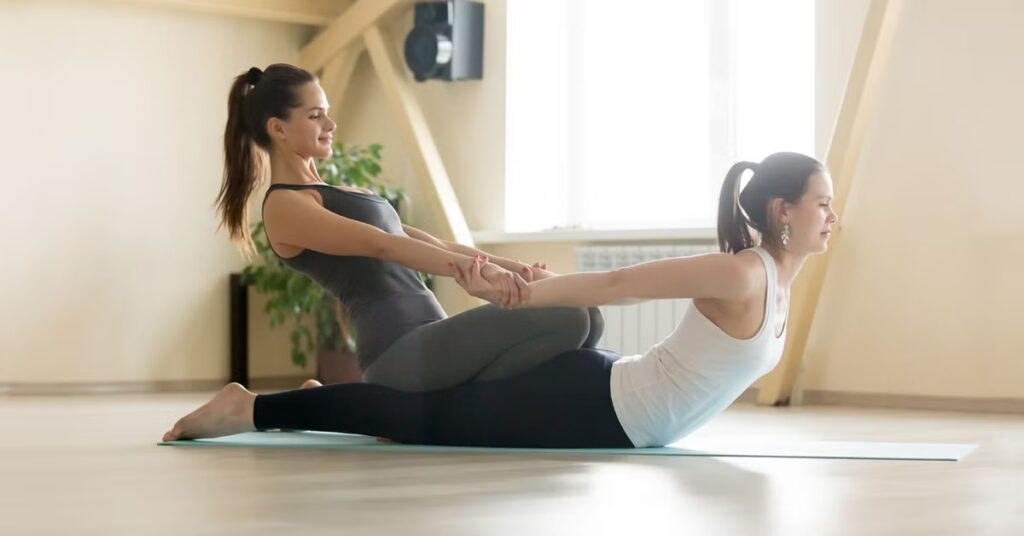
- Dual ground poses (both on the floor)
- Assisted flexibility poses (one supports the other)
- Acro yoga lifts (base + flyer)
- Couple yoga stretches
- Mirror flow sequences
Benefits of Partner Yoga Poses for 2
People practice partner yoga for different reasons. Here are the most common benefits:
1. Better Flexibility
One partner can gently deepen stretches without forcing muscles.
2. Improved Balance & Strength
Standing and acro poses teach stability and body control.
3. Trust & Communication
Couples and friends learn to communicate physically and verbally.

4. Stress Relief & Bonding
Breathing together regulates the parasympathetic nervous system, reducing stress.
5. More Fun Than Solo Yoga
Practicing with someone increases motivation and consistency.
12 Yoga Poses for 2 People: Easy to Advanced Partner Positions
Below are the most popular and effective yoga poses for two people, categorized by difficulty.
Easy Yoga Poses for 2 People — Best Beginner Partner Positions
These are safe, simple, and great for newcomers.
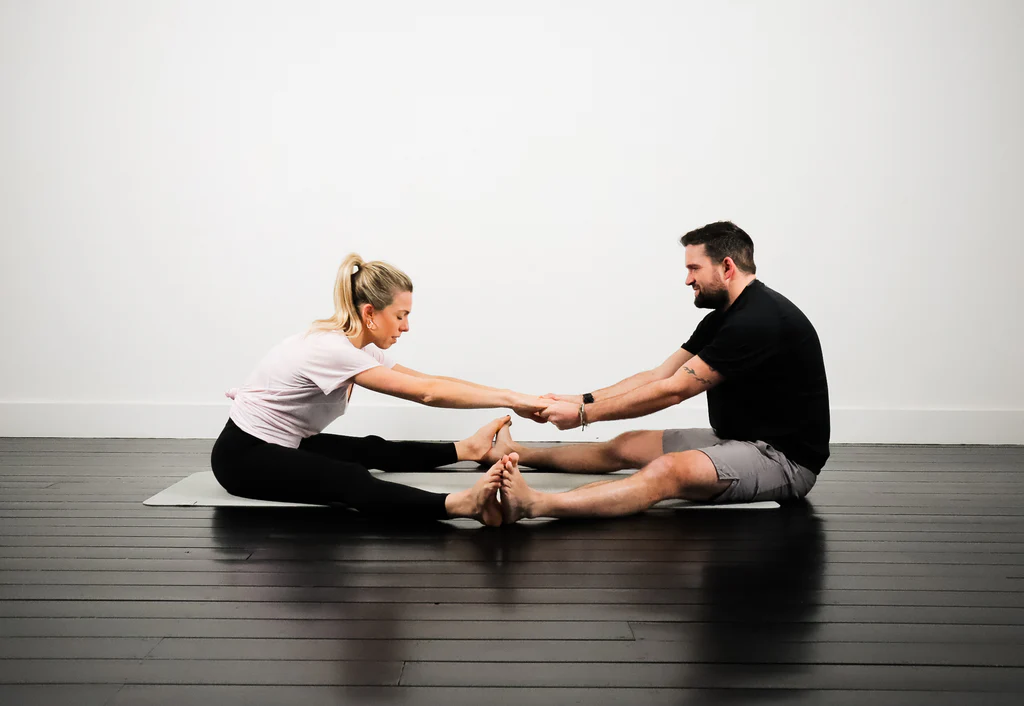
1. Partner Seated Forward Fold
How to do it:
- Sit facing each other with legs extended.
- Both partners hold each other’s wrists.
- One person gently leans back while the other folds forward.
- Hold for 20–30 seconds, then switch roles.
Benefits:
- Stretches hamstrings & low back
- Builds cooperation and breathing awareness
Breath cue: Inhale to lengthen your spine tall; exhale slowly as you fold deeper into the stretch — let your partner’s gentle resistance guide you, not force you.
Common mistake: Avoid rounding the lower back like a “C” shape. Both partners should keep their spines long and chests open, even if the fold is not deep.
Modification: If hamstrings are tight, bend both knees slightly and hold a yoga strap or towel around each other’s feet instead of grabbing wrists.
2. Back-to-Back Seated Meditation
How to do it:
- Sit cross-legged back-to-back.
- Align spines tall, relax shoulders.
- Close eyes and sync breathing for 1–3 minutes.
Benefits:
- Enhances breath awareness
- Improves posture
- Builds connection and calmness
Breath cue: Inhale together for 4 counts, exhale together for 6 counts. After 2 minutes, try to feel each other’s ribcage expand against your back — this is the core of this pose.
Common mistake: Do not let the lower back collapse backward. Both partners press their sacrum (lower back flat bone) gently toward each other to maintain spinal length.
Modification: Sit on a folded blanket or yoga block if the hips are tight and the pelvis tilts backward — this instantly makes upright sitting easier.
3. Twin Tree Pose

How to do it:
- Stand side-by-side touching shoulders.
- Each partner lifts outside foot to inner thigh/calf.
- Inner arms reach overhead and touch palms.
Benefits:
- Improves balance & stability
- Trains focus and alignment
Breath cue: Inhale as you root your standing foot down and grow tall; exhale and gently press your inner shoulder and palm into your partner’s — this connection is your balance anchor.
Common mistake: Never place your lifted foot directly on the knee joint — this puts lateral stress on the knee. Place it either above the knee on the inner thigh, or below on the inner calf.
Modification: Beginners can keep the lifted foot resting on the ankle of the standing leg (“kickstand” position) until balance improves.
4. Partner Chair Pose

How to do it:
- Stand back-to-back.
- Slowly squat together into a seated position.
- Hold for 15–30 seconds.
Benefits:
- Strengthens quads, glutes & core
- Improves coordination and timing
Breath cue: Inhale at the top as you both stand. Exhale slowly as you both lower together — try to make the exhale last the full duration of the descent.
Common mistake: Do not let your knees cave inward as you squat. Both partners should press their backs firmly into each other — the back-to-back contact is what makes this pose work. If you lose contact, you lose stability.
Modification: Only squat as low as feels comfortable — even a 30-degree bend is effective. Gradually increase depth over multiple sessions.
5. Double Child’s Pose
How to do it:
- One partner goes into child’s pose.
- The second partner kneels behind and lies backward across their lower back.
- Breathe for 60 seconds.
Benefits:
- Relaxes back muscles
- Great cool-down pose
Breath cue: The person in child’s pose breathes into their lower back — feel your back rise against your partner’s weight on the exhale. This gentle compression and release is deeply relaxing.
Common mistake: The partner lying back should not put all their weight directly on the spine — distribute weight across the full width of the lower back and use your feet on the floor for support.
Modification: If the partner on top feels discomfort, place a folded blanket between both bodies as a cushion.
Intermediate Yoga Positions for 2 — Build Strength Together
Best for pairs with moderate strength and balance.
6. Double Downward Dog

How to do it:
- Partner A enters downward dog.
- Partner B steps feet onto Partner A’s lower back or hips into a folded dog stretch.
Benefits:
- Stretches shoulders & hamstrings
- Strengthens arms and core
Breath cue: Partner A (base): inhale to press your palms firmly into the mat and exhale to push your hips higher. Partner B (top): breathe slowly and let gravity do the work — no need to push or force.
Common mistake: Partner B should place their feet on the hip bones or lower back — NOT on the spine or tailbone. Check placement before adding any weight.
Modification: Partner B can start by simply placing hands on Partner A’s lower back while standing, letting Partner A build strength before adding foot pressure.
7. Double Boat Pose

How to do it:
- Sit facing each other.
- Hold hands, lift legs into a V-shape touching soles of feet.
- Balance for 10–30 seconds.
Benefits:
- Core strength
- Spine stability
- Partner balance
Breath cue: Inhale to sit tall and engage your core; exhale as you extend your legs. Keep breathing steadily — holding your breath will make you tip over.
Common mistake: Do not grip each other’s hands so tightly that you pull each other forward. Hold hands for connection and light support, not as an anchor.
Modification: Keep knees bent at 90 degrees (tabletop position) if extending legs fully causes the back to round. Build to straight legs over time.
8. Partner Plank High-Five

How to do it:
- Both partners hold high plank facing each other.
- Lift opposite hands to high-five.
- Continue alternating for 10–20 reps.
Benefits:
- Builds upper body strength
- Fun cardio coordination move
Breath cue: Exhale as you lift your hand to high-five — this protects your core during the lateral shift of weight. Inhale as you return your hand to the floor.
Common mistake: Do not let your hips drop or rotate when you lift one hand. Squeeze your glutes and brace your core before every single high-five.
Modification: Drop to your knees (modified plank) if a full high plank is too challenging — this reduces the core demand while still building coordination.
9. Standing Forward Fold with Backbend Assist
How to do it:
- Partner A folds forward.
- Partner B stands behind, places hands on lower back and gently lifts chest upward.
Benefits:
- Deepens hamstring & chest stretches
- Opens shoulders
Breath cue: Partner A (folding): exhale deeply to surrender into the fold. As you exhale more, Partner B uses that moment to gently deepen the assist — move with the breath, not against it.
Common mistake: Partner B must never push suddenly or without communication. Always ask before adding pressure and increase depth gradually over several exhales.
Modification: Partner A can bend their knees generously if the hamstrings are tight — a bent-knee forward fold with full spinal lengthening is more beneficial than a straight-leg fold with a rounded back.
Advanced Acro Yoga Poses for 2: Base & Flyer Positions
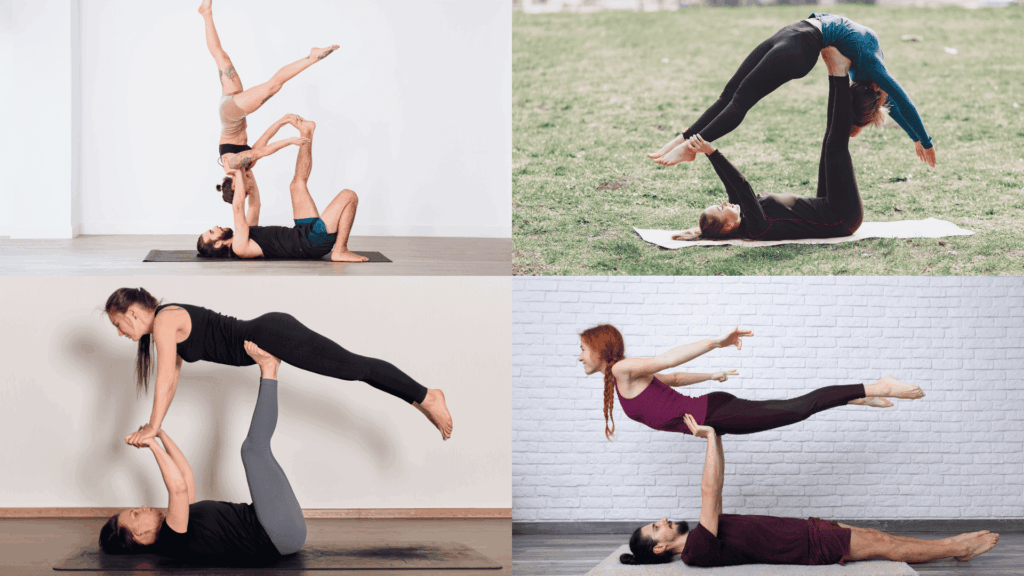
These require trust, strength, and proper spotting.
If you are looking for gymnastics-inspired easy BFF 2 person yoga poses, you are in the right place. The acro yoga positions in this section — particularly Front Plank and Flying Bird Pose — draw directly from partner gymnastics and acrobatics. They are the yoga world’s version of gymnastics partner work: one person as the stable base, one person as the elevated flyer. You do not need a gymnastics background to try them, but if you have one, you will find these positions very familiar.
10. Front Plank (Acro Base & Flyer)
How to do it:
- Partner A (base) lies on back and lifts legs.
- Partner B (flyer) balances hips on base’s feet.
- Connect hands for stability.
Benefits:
- Strengthens core, glutes & arms
- Improves balance and mental focus
Breath cue: Base: exhale as the flyer mounts and finds their balance. Once stable, both partners breathe together in long, slow cycles — this reduces tension and wobble.
Common mistake: Base must keep their feet flexed with toes pointing toward the ceiling — letting feet sickle (turn inward) causes the flyer to slip. The base’s leg angle should be vertical, not tilted.
Modification: Beginners should have a third person spotter standing alongside the flyer until both partners are comfortable with the balance.
11. Flying Bird Pose

How to do it:
- Base lies on back, feet on flyer’s hips.
- Flyer leans forward, arms extended.
- Base lifts flyer into position.
Benefits:
- Improves shoulder mobility
- Full-body strength challenge
Breath cue: Flyer: inhale as you extend your arms and body forward into the “bird” shape — think long, not forced. Exhale slowly and maintain a steady gaze downward at the base.
Common mistake: Flyer should not look up or crane their neck — this shifts the center of gravity and makes the pose unstable. Keep a neutral neck and gaze slightly downward.
Modification: Practice the base position first with no flyer — base lies on back with legs vertical, feet flexed, and simply holds this for 30 seconds to build confidence and leg strength.
12. Throne Pose (Acro Yoga)
How to do it:
- Base supports flyer on bent feet.
- Flyer sits upright as if on a chair.
Benefits:
- Advanced balance control
- Requires clear communication
Breath cue: Both partners breathe together throughout — the moment you feel you need to hold your breath, exit the pose safely. Steady breath is your warning signal.
Common mistake: The base must keep their feet parallel and hip-width — not angled outward. Angled feet make the “seat” unstable and can cause the flyer to slip sideways.
Modification: Flyer can hold a spotter’s hands on either side until they feel stable enough to let go and balance independently.
Safety Tips for Yoga Poses for 2
Partner yoga is rewarding, but safety matters.
Follow these rules:
✔ Warm up 5–10 minutes before
✔ Communicate verbally (especially while balancing)
✔ Move slowly into poses
✔ Use thick yoga mats for cushioning
✔ Avoid forcing stretches
✔ Stop if pain or numbness occurs
✔ Spot each other during acro poses
If you’re unsure, start with ground-based poses and progress over time.
Who Can Do Yoga for Two? (All Ages & Fitness Levels)
Who Can Practice
Partner yoga is also a wonderful activity for parents and children together. For kids aged 6 and up, the best yoga poses for 2 to try are Twin Tree Pose (great for focus and balance), Double Child’s Pose (kids love the gentle pressure), and Partner Chair Pose (a fun squat challenge that makes kids laugh). Keep sessions short — 10 to 15 minutes is plenty — and let the child lead the pace. The goal is play, not perfection.
Partner yoga works for:
- Couples
- Best friends
- Parents & kids
- Roommates
- Yoga teachers & students
- Athletes
- Acro yoga enthusiasts
It is not limited by age as long as mobility is considered.
Do You Need Special Equipment?
No equipment is required. However, helpful additions include:
Optional props:
- Yoga mats (2)
- Yoga blocks
- Yoga straps
- Cushions or bolsters
For outdoor practice:
- Grass or beach surface works great
BFF Yoga Poses for 2: Easy Best Friend Partner Positions
If you have ever seen partner yoga all over your Instagram or TikTok feed — two friends laughing in a tree pose or sitting back-to-back with their eyes closed — those are BFF yoga poses for 2, and they are far easier than they look. These are the three best friend yoga poses you can try today with zero flexibility and zero experience
1. TWIN TREE POSE
The One You Have Seen All Over Social Media This is the most photographed BFF yoga pose for 2 people. You stand side by side, each lift one foot to your inner calf or thigh, and press your inner palms together overhead. It looks impressive, it takes about 30 seconds to set up, and it is genuinely fun to attempt — expect to wobble and laugh. This is the definition of an easy BFF 2 person yoga pose, and it works even if one of you has never done yoga before. Why BFFs love it: It requires real teamwork to balance. The moment you both hold it is genuinely satisfying. Photo tip: Have a third friend shoot from a low angle — it makes the pose look stunning on camera.
2. PARTNER SEATED FORWARD FOLD
The One That Actually Stretches You Sit facing your best friend with legs straight, hold each other’s wrists, and take turns gently folding forward while the other leans back as resistance. This is a two person bff yoga pose that doubles as a legitimate hamstring stretch. The reciprocal trust — you are literally pulling each other deeper into the pose — makes it feel different from anything you do solo. Why BFFs love it: You can hold a full conversation while doing it. It feels like bonding, not a workout. No flexibility needed: Bend your knees as much as you need. The stretch still works.
3. BACK-TO-BACK SEATED MEDITATION
The Most Underrated BFF Pose Sit cross-legged back to back with your best friend, spines touching, and just breathe together for 2–3 minutes. That is it. No strength required, no flexibility required — just a friend willing to sit still with you for two minutes. The experience of feeling another person breathe against your back is surprisingly calming. It is one of the most simple yet weirdly powerful easy bff 2 person yoga poses you can do. Why BFFs love it: It genuinely reduces stress. Most people who try it once keep coming back to it. Make it yours: Add a playlist of 2–3 calm songs as a timer.
These three BFF yoga poses for 2 require nothing but a friend willing to try. No mat, no gear, no experience. They are also the most likely to end up on your camera roll — so clear some space and hit record.
Your First 5-Minute Partner Yoga Routine (Easy Yoga Positions for 2 Beginners)
Not sure where to start with yoga for two? Here is a simple beginner routine that takes exactly 5 minutes, uses four poses from this guide, and requires zero experience. Do it in your living room — no mats required for the first two poses.
Minute 1–2: Back-to-Back Seated Meditation
Sit cross-legged back to back, close your eyes, and breathe together for 2 full minutes. This is your warm-up. It syncs your energy and settles any awkwardness before you move.
Minute 2–3: Partner Seated Forward Fold
Sit facing each other, hold wrists, and take turns gently folding for 30 seconds each side. This warms up the hamstrings and lower back before standing poses.
Minute 3–4: Twin Tree Pose
Stand side by side, connect inner palms, and each lift the outside foot to the inner calf. Hold for 30 seconds, then switch sides. This is the Instagram pose — take the photo.
Minute 4–5: Double Child’s Pose
One partner goes into child’s pose, the second lies back across their lower back. Hold for 60 seconds, breathing slowly. This is your cool-down. The compression on the lower back feels deeply relaxing after the standing balance. That is one complete beginner routine using easy yoga poses for 2. Repeat it 2–3 times per week and within a month you will feel a noticeable difference in flexibility and partner communication.
Frequently Asked Questions (FAQ)
Q1: What are the easiest yoga poses for 2 beginners?
The easiest yoga poses for 2 beginners are the Partner Seated Forward Fold and Back-to-Back Seated Meditation. Both are done seated on the floor, require no strength or flexibility, and can be practiced for the first time with zero yoga experience. Start with these two and hold each pose for 20–30 seconds before moving on.
Q2: Can you do yoga poses for 2 without any flexibility?
Yes, completely. Most beginner yoga poses for 2 are designed to build flexibility over time, not require it upfront. Poses like Partner Chair Pose and Twin Tree Pose focus on balance and connection rather than deep stretching. Modifications such as bent knees, yoga straps, and blankets are built into every pose in this guide so that anyone — at any level — can participate safely from day one.
Q3: What are the best yoga poses for 2 for couples?
The best yoga poses for 2 people in a romantic relationship are the ones that build physical touch and communication. Partner Seated Forward Fold creates gentle reciprocal trust; Back-to-Back Seated Meditation is one of the most calming shared experiences in partner yoga; and Double Boat Pose requires constant eye contact and teamwork. For couples new to yoga, start with these three before progressing to standing or acro poses.
Q4: What are the best BFF yoga poses for 2 people?
The best BFF yoga poses for 2 are fun, photogenic, and low-pressure — perfect for best friends who want to move together without a serious fitness agenda. Twin Tree Pose, Partner Plank High-Five, and Double Downward Dog are the three most popular between friends because they are playful, quick to set up, and require genuine teamwork without demanding advanced skill. These are also the poses you will see most often on social media.
Q5: How long should a partner yoga session last?
For beginners, 20–30 minutes is plenty. A beginner session might include a 5-minute warmup (light individual stretching), 3–4 seated partner poses held for 30–60 seconds each, 2–3 standing poses, and a 5-minute cool-down in Double Child’s Pose. Experienced pairs doing intermediate or acro sequences can extend sessions to 45–60 minutes. There is no minimum requirement — even 10 minutes of yoga poses for 2 produces real benefits.
Q6: Is acro yoga the same as yoga poses for 2?
No. Yoga poses for 2 is a broad category that includes seated stretches, standing balance poses, and partner breathing exercises — most of which require no special skill. Acro yoga is a specific subset that involves one person (the base) supporting or lifting another (the flyer) off the ground. All acro yoga involves yoga poses for 2, but not all yoga poses for 2 are acro yoga. Beginners should always start with ground-based partner poses before attempting any acro yoga lifts.
Q7: How do you do Double Downward Dog safely?
To do Double Downward Dog safely, the base partner enters a strong, stable downward dog first — arms pressing firmly into the mat, hips high, heels reaching toward the floor. The second partner then places their hands on the floor about 2 feet in front of the base’s hands, and carefully steps their feet — one at a time — onto the base’s hip bones or lower back (never the spine). The top partner should keep most of their weight in their hands at first, gradually transferring more to their feet as the base confirms comfort. Always communicate before adding pressure and exit the pose together on a count of three.
Q8: What are easy yoga poses for 2 people of different heights?
Most easy yoga poses for 2 work regardless of height difference. The best options when partners are different heights are Partner Seated Forward Fold (height does not matter when seated), Back-to-Back Meditation (completely height-neutral), and Partner Chair Pose (back-to-back squat where height difference can be accommodated by adjusting your squat depth). Avoid Twin Tree Pose if there is a large height gap — it makes the inner palm connection difficult.
Q9: Can you do yoga poses for 2 with a complete stranger or classmate?
Yes. Many yoga studios and school yoga classes include partner yoga. The key is clear verbal communication before and during each pose — always ask “Is this pressure okay?” before assisting your partner. Ground-based poses like Partner Seated Forward Fold, Back-to-Back Meditation, and Double Boat Pose are ideal for practicing with someone you just met because they involve minimal contact and easy exit points. Avoid acro yoga lifts with strangers until trust is established.
Q10: What is the difference between yoga poses for 2 and couples yoga?
The terms are used interchangeably, but there is a small distinction. Yoga poses for 2 refers to any partner yoga practice between two people — friends, siblings, classmates, or strangers. Couples yoga specifically describes partner yoga practiced in a romantic relationship, often with an emphasis on trust-building and emotional connection. All couples yoga is yoga for 2, but yoga for 2 is not exclusively for romantic couples. The poses are identical — only the relationship context differs.
Conclusion: Why You Should Try Yoga Poses for 2
Practicing yoga poses for 2 is more than a workout — it’s an experience that builds trust, connection, and shared joy. Whether you’re doing gentle stretches or advanced acro yoga lifts, you’ll gain:
✔ Flexibility
✔ Strength
✔ Communication skills
✔ Balance
✔ Shared laughter & bonding
Partner yoga proves that fitness doesn’t have to be solo — you can heal, move, and grow together. If you’re ready to start, choose a friend or loved one, roll out two mats, and give a few of these poses a try today!