

Partner yoga has exploded in popularity over the past few years, and for good reason. Whether you’re looking to strengthen your relationship, add a playful element to your practice, or simply push your flexibility boundaries, yoga poses for two people offer benefits that solo practice can’t match. In fact, recent wellness surveys from 2025 show that couples who practice partner yoga together report 47% higher relationship satisfaction and 63% better communication skills compared to those who don’t.
- Quick Answer: Best Yoga Poses for Two People
- Table of Contents
- What is Partner Yoga and Why Practice It? {#what-is-partner-yoga}
- Benefits of 2 Person Yoga Poses {#benefits}
- Essential Safety Tips Before You Begin {#safety-tips}
- 15 Best Yoga Poses for Two People {#best-poses}
- Easy 2 Person Yoga Challenge Ideas {#challenge-ideas}
- Common Mistakes to Avoid {#mistakes}
- FAQ: Your Partner Yoga Questions Answered {#faq}
- Conclusion: Taking Your Partner Yoga Journey Forward
But here’s the thing: jumping into advanced 2 person yoga poses without proper guidance can lead to frustration or even injury. You need poses that build trust, improve coordination, and gradually increase difficulty. In this comprehensive guide, you’ll discover 15 accessible yet effective yoga poses for two people, complete with step-by-step instructions, modifications for beginners, and expert tips to make your partner yoga journey both safe and transformative.
Quick Answer: Best Yoga Poses for Two People
Looking for the perfect 2 person yoga poses to start your practice? Here are the essentials:
- Partner Forward Fold – Excellent for beginners, stretches hamstrings and spine
- Double Tree Pose – Improves balance and strengthens connection
- Partner Boat Pose – Core strengthening while facing your partner
- Back-to-Back Chair Pose – Builds leg strength and trust
- Seated Spinal Twist – Enhances flexibility and communication
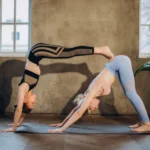
- Partner Downward Dog – Intermediate pose that deepens stretches
These poses work for beginners and experienced yogis alike, requiring minimal space and no equipment beyond a standard yoga mat.
Table of Contents
- What is Partner Yoga and Why Practice It?
- Benefits of 2 Person Yoga Poses
- Essential Safety Tips Before You Begin
- 15 Best Yoga Poses for Two People
- Easy 2 Person Yoga Challenge Ideas
- Common Mistakes to Avoid
- FAQ: Your Partner Yoga Questions Answered
What is Partner Yoga and Why Practice It? {#what-is-partner-yoga}
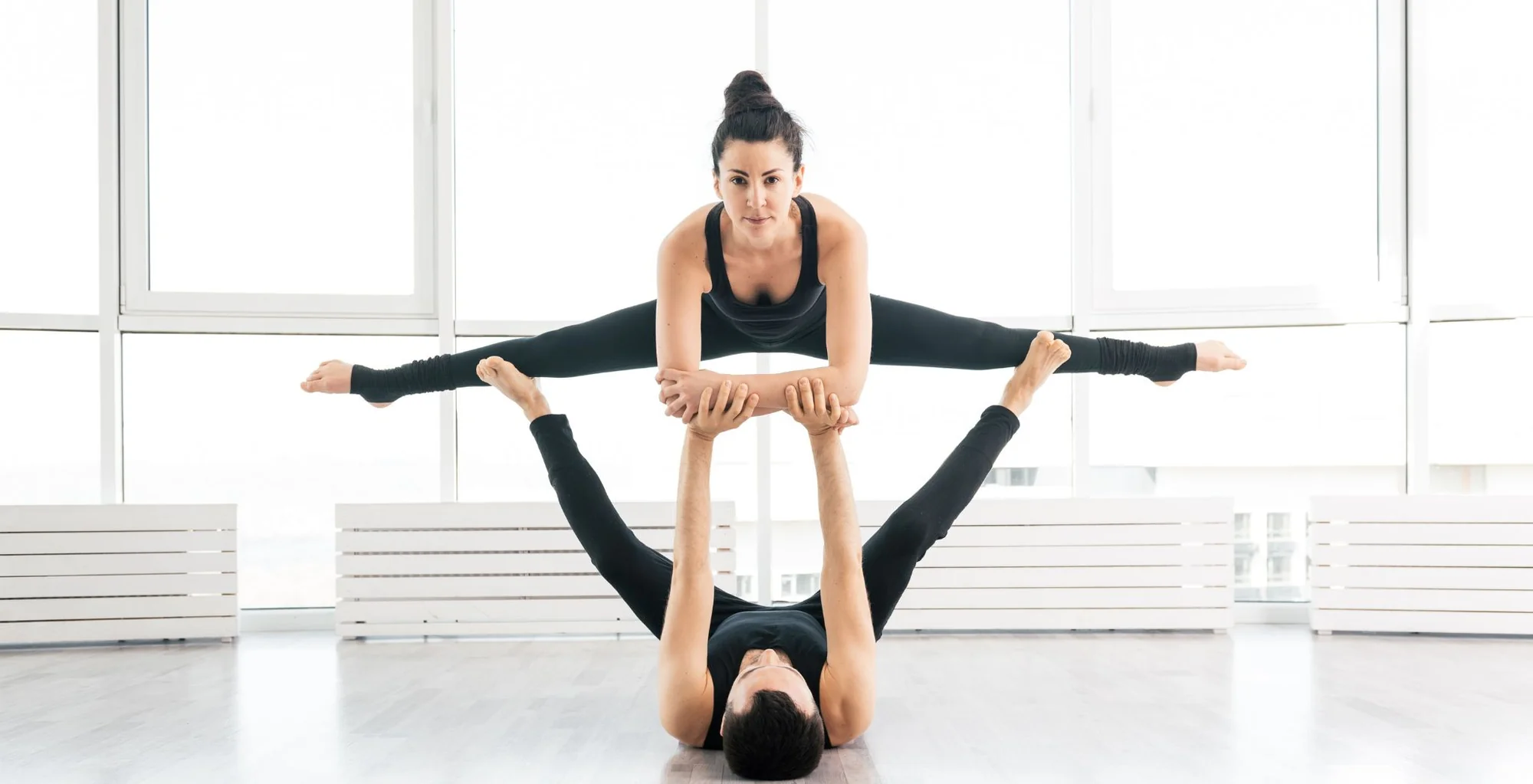
Partner yoga, also known as couples yoga or acro yoga (in more advanced forms), involves two people working together to achieve yoga poses that either support each other, mirror movements, or create interconnected postures. Unlike traditional solo practice, 2 person yoga poses require communication, trust, and synchronized breathing.
The Growing Trend in 2026
As of 2026, partner yoga has evolved beyond romantic couples. Fitness studios now offer specialized classes for friends, parent-child duos, and even corporate team-building sessions. The practice combines elements of traditional Hatha yoga with Thai massage techniques and playful acrobatic elements, making it both therapeutic and entertaining.
What makes it different from regular yoga? While solo yoga focuses on individual alignment and internal awareness, yoga poses for two people emphasize:
- Mutual support and assistance in achieving deeper stretches
- Enhanced accountability as you can’t skip poses without affecting your partner
- Trust-building exercises that translate beyond the mat
- Shared energy that can make challenging poses feel more achievable
The beauty of couples yoga poses lies in their accessibility. You don’t need to be advanced yogis or incredibly flexible. Most 2 person yoga poses easy variations exist that allow complete beginners to participate fully while still experiencing profound benefits.
Benefits of 2 Person Yoga Poses {#benefits}
Physical Benefits
Deeper Stretches: Your partner can help you achieve positions that would be impossible alone. Research from the International Journal of Yoga Therapy (2025) found that partner-assisted stretches increased flexibility by an average of 34% compared to solo stretching over an 8-week period.
Improved Balance: Many 2 person yoga challenge poses require you to maintain equilibrium while coordinating with another person’s movements. This dual focus strengthens proprioception—your body’s ability to sense its position in space.
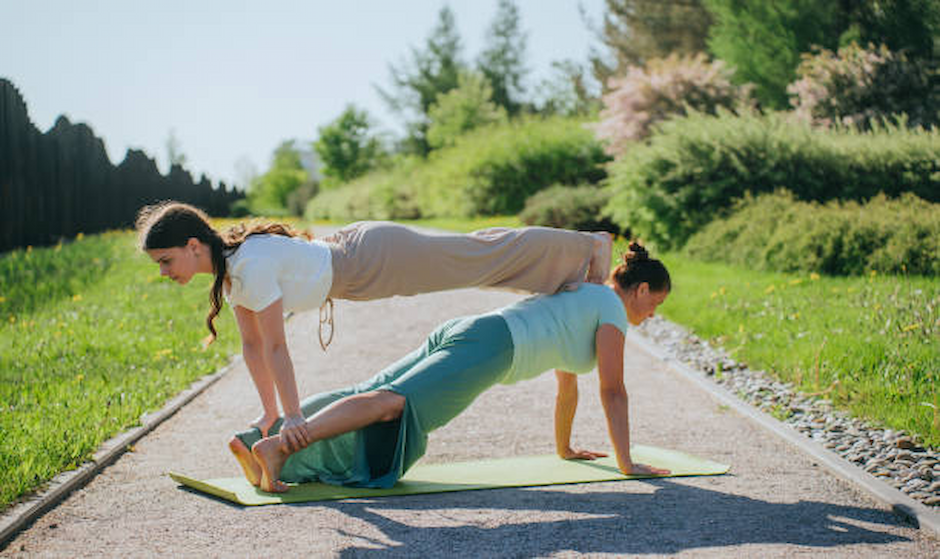
Core Strengthening: Poses like Partner Boat and Double Plank engage your core muscles intensely as you stabilize both your body and your partner’s weight.
Better Alignment: Having someone observe your posture provides immediate feedback. Your partner acts as a mirror, helping you notice and correct alignment issues you might miss when practicing alone.
Mental and Emotional Benefits
Stress Reduction: A 2024 study published in the Journal of Wellness Research revealed that participants practicing partner yoga experienced 41% lower cortisol levels compared to those practicing solo yoga.
Enhanced Communication: You must verbally communicate comfort levels, adjustments, and intentions. This skill naturally extends to other areas of your relationship.
Increased Trust: Supporting your partner’s weight or being supported requires vulnerability and trust. Successfully completing yoga poses for 2 builds confidence in your partnership.
Mindful Connection: Partner yoga demands present-moment awareness. You can’t be mentally elsewhere when someone is depending on you for physical support.
Relationship Benefits
According to relationship therapists surveyed in 2025, couples who practice yoga together report:
- 52% improvement in physical intimacy
- 58% better conflict resolution skills
- 67% increased quality time together
- 71% more laughter and playfulness in their relationship
These benefits aren’t limited to romantic partnerships. Friends practicing together report stronger bonds, while parent-child partner yoga creates special moments of connection in busy family schedules.
Essential Safety Tips Before You Begin {#safety-tips}
Communication is Everything
Before attempting any 2 person yoga poses, establish clear communication signals:
Verbal Cues: Agree on phrases like “hold” (maintain position), “ease up” (reduce pressure), and “release” (exit the pose).
Check-ins: Regularly ask “How does that feel?” throughout the pose. Never push through pain to accommodate your partner.
Honest Feedback: Create a judgment-free zone where both partners can express discomfort without guilt.
Physical Preparation
Warm Up Together: Spend 10-15 minutes doing light cardio and dynamic stretches before attempting couples yoga poses. Cold muscles are more prone to injury.
Know Your Limitations: If you have recent injuries, chronic conditions, or significant flexibility differences, modify poses accordingly or consult a yoga instructor first.
Size and Strength Differences: Most yoga poses for two people can accommodate different body types, but be realistic. A 250-pound person should not be the “flyer” on a 120-pound base in acrobatic poses.
Environment Setup
Adequate Space: Clear a 10×10 foot area minimum with soft flooring or multiple yoga mats layered for cushioning.
Proper Lighting: Ensure you can see each other clearly to monitor form and facial expressions.
Remove Obstacles: Clear furniture, sharp objects, and fragile items from your practice area.
Use Props: Keep yoga blocks, straps, and bolsters nearby for modifications.
When to Avoid Partner Yoga
Skip your practice if either partner is:
- Experiencing acute injury or severe pain
- Under the influence of alcohol or medications affecting balance
- Feeling unusually fatigued or unwell
- In a conflict that hasn’t been resolved (resentment can manifest as unsafe practice)
15 Best Yoga Poses for Two People {#best-poses}
Beginner Level: 2 Person Yoga Poses Easy
1. Partner Forward Fold (Seated)
What it targets: Hamstrings, lower back, shoulders
How to do it:
- Sit facing each other with legs extended, feet touching
- Hold each other’s forearms or wrists
- One partner folds forward while the other leans back, creating gentle traction
- Hold for 30 seconds, then switch roles
- Keep knees slightly bent if hamstrings are tight
Why it works: This pose provides an assisted stretch that’s impossible to achieve alone, making it perfect for beginners exploring yoga poses for 2 easy options.
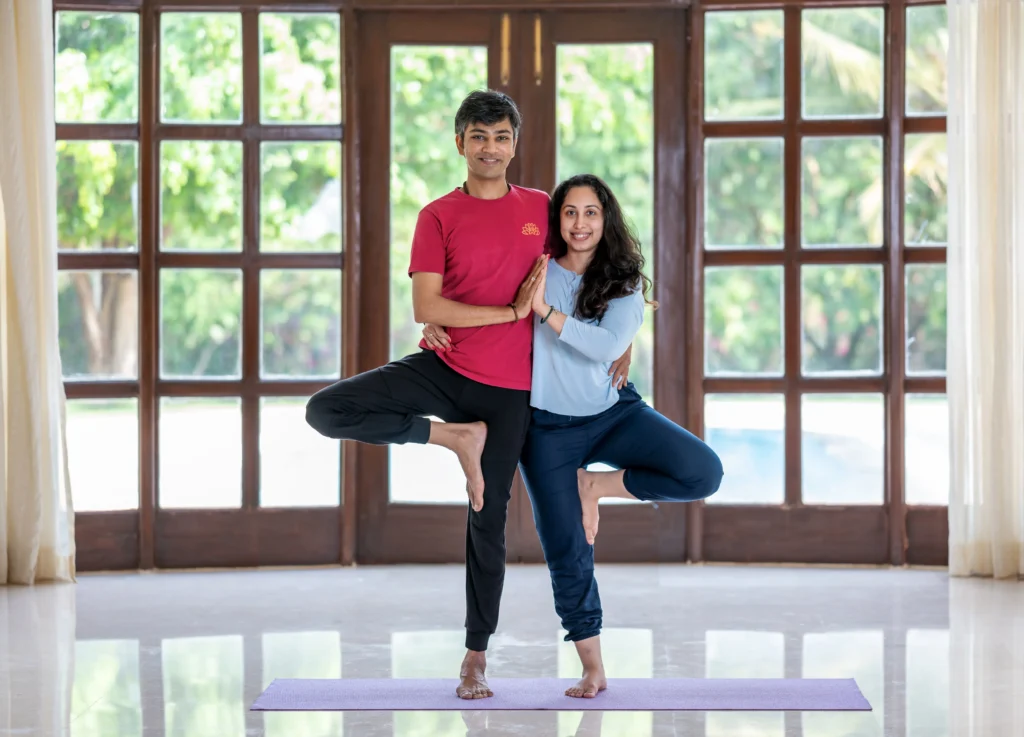
2. Double Tree Pose
What it targets: Balance, inner thighs, core stability
How to do it:
- Stand side by side, about 6 inches apart
- Place inside arms around each other’s waists or shoulders
- Both partners shift weight to inside legs
- Bring outside feet to inner ankles, calves, or thighs
- Press into each other for mutual support
- Hold for 30-60 seconds, then switch sides
Pro tip: Make eye contact with each other rather than looking down to improve balance.
3. Partner Breathing Exercise
What it targets: Breath synchronization, relaxation, connection
How to do it:
- Sit back-to-back in comfortable cross-legged position
- Press your spines together gently
- Close eyes and feel your partner’s breath rhythm
- Gradually synchronize your breathing patterns
- Continue for 3-5 minutes
Why it’s essential: This isn’t a physical pose but a crucial foundation for all 2 person yoga poses. Synchronized breathing creates harmony and prevents injury.
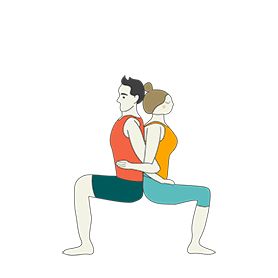
4. Back-to-Back Chair Pose
What it targets: Quadriceps, glutes, core, trust
How to do it:
- Stand back-to-back, pressing firmly against each other
- Link arms at the elbows
- Slowly walk feet forward while sliding down into a squat position
- Support each other’s weight equally
- Hold for 20-30 seconds
- Walk feet back in to stand up together
Common mistake: One partner leaning too heavily on the other. Aim for 50/50 weight distribution.
5. Partner Seated Spinal Twist
What it targets: Spine flexibility, obliques, digestion
How to do it:
- Sit back-to-back in cross-legged position
- Both partners inhale and lengthen spine
- On exhale, both twist to the right, placing left hand on right knee
- Right arm reaches around to hold partner’s left knee or thigh
- Hold for 5 breaths, then switch directions
Therapeutic benefit: This pose provides gentle traction that deepens the spinal twist beyond what you could achieve alone.
Intermediate Level: Couples Yoga Poses
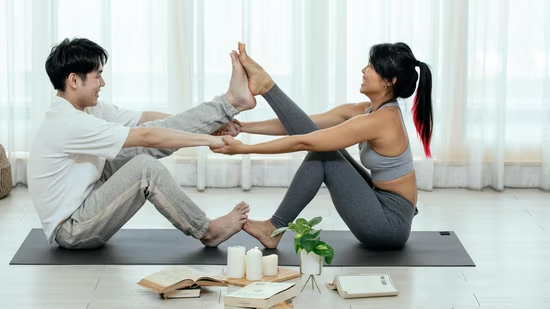
6. Partner Boat Pose
What it targets: Core strength, hip flexors, balance
How to do it:
- Sit facing each other with knees bent, feet flat
- Hold each other’s hands or forearms
- Lift feet off ground and press soles together
- Slowly straighten legs, forming a “V” shape with your bodies
- Hold for 15-30 seconds
- Engage core to prevent lower back strain
Progression: Once stable, try releasing hands and extending arms forward.
7. Double Downward Dog
What it targets: Shoulders, hamstrings, back strength
How to do it:
- Partner 1 comes into Downward Dog
- Partner 2 places hands shoulder-width apart, about 1 foot in front of Partner 1’s hands
- Partner 2 carefully walks feet up Partner 1’s back, placing feet on lower back/sacrum area
- Partner 2 straightens arms and legs into Downward Dog position
- Hold for 15-30 seconds
- Partner 2 carefully walks feet down Partner 1’s legs to exit
Safety note: Avoid this pose if either partner has wrist, shoulder, or lower back injuries.
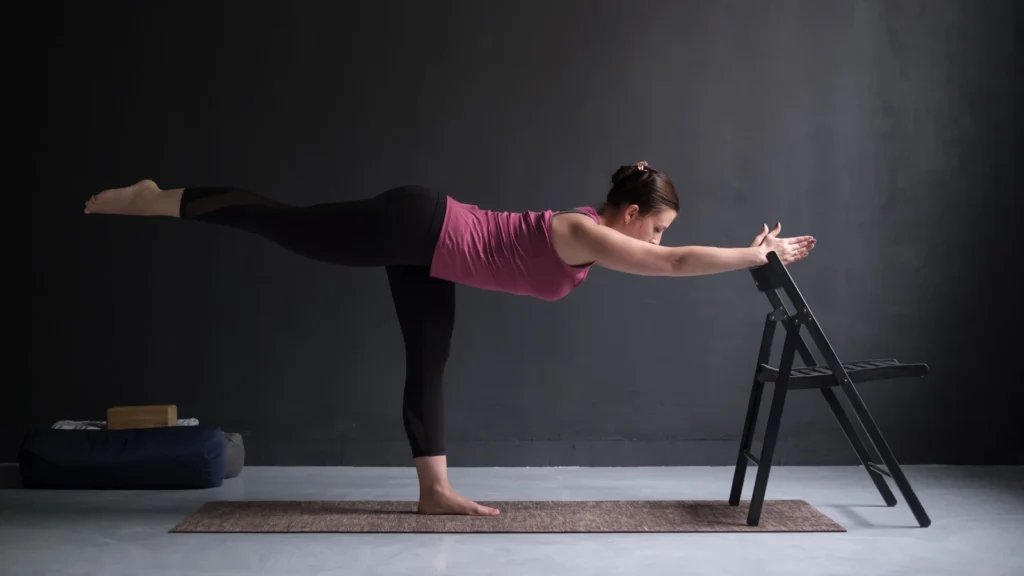
8. Partner Warrior III
What it targets: Balance, legs, core, communication
How to do it:
- Stand facing each other, arm’s length apart
- Both partners shift weight to right leg
- Simultaneously lift left legs back while folding forward
- Hold each other’s forearms when torsos are parallel to ground
- Create a straight line from head to left heel
- Hold for 20 seconds, then switch sides
Visual cue: You should form a T-shape mirror image of each other.
9. Temple Pose (Standing Partner Fold)
What it targets: Shoulders, upper back, hamstrings, trust
How to do it:
- Stand facing each other, about 3 feet apart
- Both partners hinge at hips and fold forward
- Place hands on each other’s shoulders or upper back
- Walk feet back until arms are straight
- Press into each other to deepen the shoulder stretch
- Hold for 45-60 seconds
Breath focus: Exhale together to release deeper into the pose.
10. Flying Bow Pose (Caution: Advanced Transition)
What it targets: Back flexibility, hip flexors, trust, core (for base)
How to do it:
- Base partner lies on back, legs bent at 90 degrees, feet facing up
- Flyer partner stands at base’s head, then leans stomach onto base’s feet
- Base straightens legs, lifting flyer into the air
- Flyer lifts chest and grabs ankles, creating bow shape
- Base holds flyer’s hands for support
- Hold for 10-20 seconds
Prerequisites: Requires strong core from base and flexible back from flyer. Practice with spotter present.
Advanced Level: 2 Person Yoga Challenge
11. Partner Headstand
What it targets: Upper body strength, balance, focus
How to do it:
- Both partners come into headstand prep position facing each other
- Lift into headstands simultaneously
- Carefully bring legs together, pressing soles of feet against each other
- Hold for 15-30 seconds
- Lower down with control
Prerequisites: Both partners must be comfortable holding independent headstands for at least 60 seconds.
12. Double Plank Pose
What it targets: Core, shoulders, coordination
How to do it:
- Partner 1 comes into plank position
- Partner 2 places hands on Partner 1’s ankles
- Partner 2 walks feet up Partner 1’s back until in plank position on top
- Hold for 15-30 seconds
- Partner 2 carefully walks down
Modification: Start with Partner 2’s feet on Partner 1’s calves instead of back for less intensity.
13. Supported Wheel Pose
What it targets: Deep backbend, shoulders, hip flexors
How to do it:
- Partner 1 lies on back and comes into Wheel pose (backbend)
- Partner 2 stands between Partner 1’s arms, facing toward their feet
- Partner 2 carefully folds forward, placing hands on Partner 1’s ankles
- Partner 2 can apply gentle traction to deepen Partner 1’s backbend
- Hold for 20-30 seconds
Communication essential: Partner 1 must clearly communicate comfort level throughout.
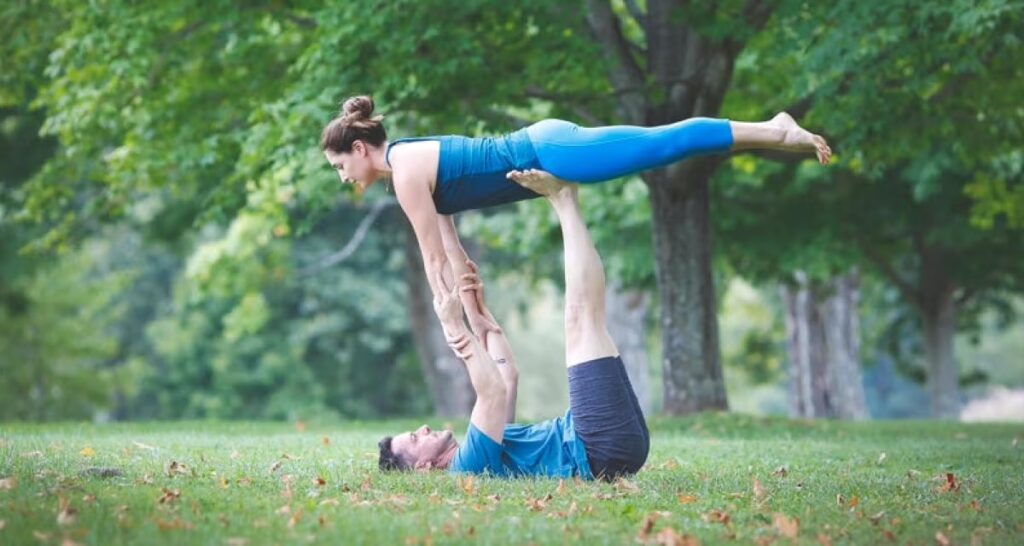
14. Flying Superman Pose
What it targets: Total body strength, balance, trust
How to do it:
- Base partner lies on back, arms and legs extended upward
- Flyer partner lies stomach-down on base’s feet and hands
- Base presses up, lifting flyer parallel to ground
- Flyer extends arms forward, legs back
- Hold for 10-20 seconds
Spotter recommended: Especially when learning this 2 person yoga challenge pose.
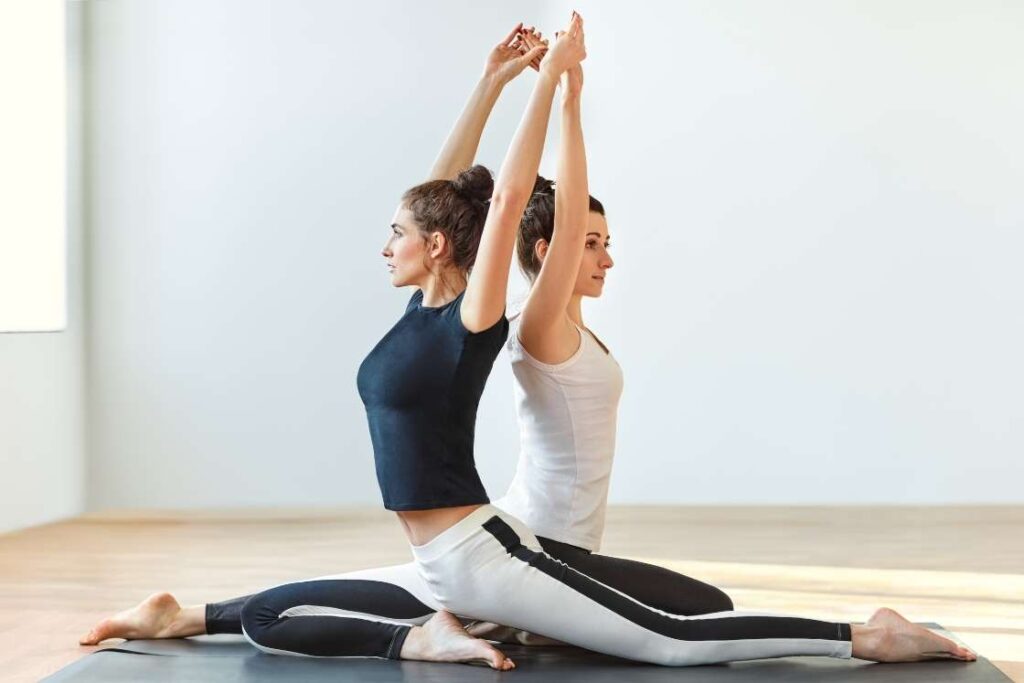
15. Partner King Pigeon Pose
What it targets: Hip flexibility, quadriceps, balance
How to do it:
- Both partners come into Pigeon pose facing the same direction
- Back legs should be on opposite sides (one left, one right)
- Reach back to grab back foot, opening chest
- Lean toward each other, free hand supporting partner’s back
- Hold for 30-45 seconds per side
Benefit: Having your partner’s support allows a deeper, safer backbend in this intense hip opener.
Easy 2 Person Yoga Challenge Ideas {#challenge-ideas}
Ready to take your practice to the next level? Try these progressive challenges:
7-Day Partner Yoga Challenge
Day 1: Master 3 beginner poses with perfect form Day 2: Hold Partner Boat Pose for 1 full minute Day 3: Complete 5 rounds of synchronized Sun Salutations Day 4: Practice without verbal cues (non-verbal communication only) Day 5: Hold Double Tree Pose for 2 minutes per side Day 6: Attempt one intermediate pose you’ve never tried Day 7: Create your own sequence combining 5 favorite poses
Photo Challenge
Document your journey by taking progress photos:
- Week 1: Basic poses
- Week 4: Notice improved form and flexibility
- Week 8: Attempt intermediate poses
- Week 12: Challenge poses
Share your progression to stay motivated and inspire others exploring yoga poses for two people.
Breath-Hold Challenge
For experienced practitioners:
- Enter Partner Boat Pose
- Take synchronized deep breath
- Hold breath while maintaining pose
- See how long you can hold (safely)
- Track progress weekly
Safety note: Exit immediately if dizzy or uncomfortable. This is advanced practice only.
Trust-Building Challenge
Practice these couples yoga poses blindfolded (one partner at a time):
- Partner Forward Fold
- Double Tree Pose
- Back-to-Back Chair Pose
This intensifies trust and proprioception awareness.
Common Mistakes to Avoid {#mistakes}
1. Skipping the Warm-Up
The mistake: Jumping directly into 2 person yoga poses without preparation.
The fix: Always spend 10 minutes warming up with light cardio and dynamic stretches. Cold muscles don’t have the elasticity needed for partner-assisted stretches.
2. Competitive Mindset
The mistake: Turning partner yoga into a competition about who’s stronger or more flexible.
The fix: Remember that yoga poses for 2 are about cooperation, not competition. Celebrate differences rather than comparing abilities.
3. Poor Communication
The mistake: Staying silent when uncomfortable or pushing through pain to please your partner.
The fix: Establish that honesty is kindness. Speak up immediately about discomfort. Your partner would rather adjust than hurt you.
4. Mismatched Weight Distribution
The mistake: One partner supporting significantly more weight than their strength allows.
The fix: In poses requiring weight-bearing, ensure the stronger/larger person acts as the base. Don’t attempt poses beyond your combined capabilities.
5. Holding Breath
The mistake: Forgetting to breathe during challenging couples yoga poses.
The fix: Count breaths aloud together (5-10 breaths per pose). This ensures consistent oxygen flow and creates rhythm.
6. Rushing Progressions
The mistake: Attempting advanced 2 person yoga challenge poses before mastering basics.
The fix: Spend at least 2-3 weeks with beginner poses before progressing. Strong foundations prevent injury and frustration.
7. Ignoring Individual Flexibility Differences
The mistake: Expecting both partners to achieve identical depth in stretches.
The fix: Use props, adjust stance width, or modify poses to accommodate different flexibility levels.
FAQ: Your Partner Yoga Questions Answered {#faq}
Q: Can you do yoga poses for two people if one partner is a beginner and the other is advanced?
A: Absolutely! In fact, having one experienced partner can be beneficial. The advanced yogi can guide proper alignment and progression while being mindful not to push the beginner too hard. Start with 2 person yoga poses easy variations and let the beginner’s comfort level dictate pace. The advanced partner gets to practice patience and teaching—valuable yoga skills often overlooked.
Q: What if my partner and I have very different body sizes?
A: Size differences are normal and manageable. For weight-bearing poses, the larger/stronger person should be the base. Many couples yoga poses like Partner Forward Fold, Seated Spinal Twist, and Double Tree Pose work beautifully regardless of size differences. Focus on poses emphasizing mutual support rather than weight-bearing acrobatics.
Q: How often should we practice partner yoga to see benefits?
A: Research from 2025 suggests practicing 2-3 times weekly for at least 30 minutes provides optimal benefits. However, even once weekly can improve flexibility, trust, and connection. Consistency matters more than frequency—better to practice 30 minutes weekly than sporadically for 2 hours.
Q: Do we need any special equipment for yoga poses for two people?
A: No specialized equipment required! You need:
- Two yoga mats (or one extra-large mat)
- Comfortable clothing that allows movement
- Optional: yoga blocks, straps, and bolsters for modifications
Most 2 person yoga poses require nothing but your bodies and willingness to connect.
Q: Can friends practice partner yoga or is it just for couples?
A: Partner yoga is for anyone willing to practice together! While marketed as “couples yoga poses,” the practice benefits all relationships: friends, siblings, parent-child, or even colleagues. The trust-building and communication skills transfer regardless of relationship type.
Q: What’s the difference between partner yoga and acro yoga?
A: Partner yoga focuses on assisted stretching, synchronized movements, and mutual support, typically with both partners maintaining ground contact. Acro yoga incorporates acrobatic elements where one partner (base) lifts the other (flyer) completely off the ground, requiring significant strength and advanced skills. Most 2 person yoga challenge poses fall somewhere on this spectrum.
Q: Is partner yoga safe during pregnancy?
A: Modified partner yoga can be safe and beneficial during pregnancy with these precautions:
- Avoid deep twists and poses compressing the abdomen
- Skip inversions after the first trimester
- Don’t lie flat on back after 20 weeks
- Focus on gentle hip openers and supported stretches
- Always consult your healthcare provider first
The partner can provide valuable support for prenatal-safe poses.
Q: How do I convince my reluctant partner to try yoga with me?
A: Start with the physical and relationship benefits rather than spiritual aspects. Emphasize:
- Improved flexibility reduces injury risk in other activities
- Stronger core benefits all physical pursuits
- Better communication skills improve the relationship
- It’s quality time together doing something new
- Try a single 15-minute session of 2 person yoga poses easy variations before committing
Many skeptical partners become enthusiasts after experiencing the connection and physical benefits firsthand.
Q: What should we do if a pose causes pain?
A: Exit the pose immediately. Pain is your body’s warning signal—never push through it. Assess what caused discomfort:
- Was alignment off? Review proper form
- Is one partner less flexible? Use modifications
- Was communication lacking? Establish clearer cues
- Is injury present? Consult healthcare provider
Discomfort during stretching is normal; sharp or joint pain is not.
Q: Can yoga poses for two people help with intimacy issues?
A: Many relationship therapists incorporate partner yoga into couples therapy. A 2024 study found that couples practicing together experienced increased oxytocin levels (the bonding hormone) and reported improved physical intimacy. The vulnerability, trust, and physical connection required in couples yoga poses often translate to emotional and physical closeness off the mat.
Q: What’s the best time of day to practice 2 person yoga poses?
A: Morning practice energizes for the day ahead, while evening practice releases accumulated stress. The best time is whenever both partners can commit to distraction-free practice. Consistency matters more than timing. Avoid practicing immediately after meals (wait 2-3 hours) or when either partner is extremely tired.
Q: How do we transition from beginner to intermediate poses safely?
A: Follow this progression:
- Master 5-6 beginner poses with perfect form
- Hold each pose comfortably for 60 seconds
- Synchronize breathing without conscious effort
- Attempt one intermediate pose per session
- Build confidence over 2-3 weeks before progressing further
Never skip foundations. Even advanced yogis return to basics regularly.
Q: Are there benefits to practicing with different partners?
A: While consistency with one partner builds deeper connection, practicing with different people offers benefits:
- Adapting to different body types improves overall skill
- Fresh perspectives on familiar poses
- Prevents codependency on one person’s support
- Builds broader community connections
However, if practicing for relationship-building specifically, consistency with one partner yields better results.
Q: What if we can’t stop laughing during practice?
A: Laughter is wonderful! It releases endorphins, reduces stress, and builds joy in your relationship. Some 2 person yoga challenge attempts will be hilarious, especially when first learning. Embrace the playfulness—it’s part of what makes partner yoga special. Just ensure you’re laughing with each other, not at mishaps that could indicate safety issues.
Q: Can partner yoga improve our communication outside of practice?
A: Yes! Research from relationship studies in 2025 shows couples practicing together develop:
- Better non-verbal communication awareness
- Increased comfort expressing needs clearly
- Improved conflict resolution (learned from adjusting poses together)
- Greater empathy from supporting each other’s challenges
These skills naturally extend beyond the yoga mat into daily interactions.
Conclusion: Taking Your Partner Yoga Journey Forward
Yoga poses for two people offer something truly special—a practice that strengthens your body while deepening your most important relationships. Whether you’re exploring 2 person yoga poses easy variations as complete beginners or tackling advanced 2 person yoga challenge sequences, the key is consistent practice, clear communication, and mutual support.
Your next steps:
- Start with 3-4 beginner poses this week
- Schedule regular practice times (even 20 minutes helps)
- Track your progress with photos or journaling
- Gradually introduce intermediate couples yoga poses
- Celebrate small wins together
Remember that every expert yogi started as a beginner. The poses that feel impossible today become accessible with patience and practice. Your partner is there not just to challenge you, but to support, encourage, and grow alongside you.
Ready to experience the transformative power of partner yoga? Grab your partner, clear some space, and start with Partner Breathing and Double Tree Pose today. Your relationship—and your body—will thank you.
Related Articles: