The human body does not have an expiry date on movement. Yet somewhere along the way, many people over 60 receive the implicit message — from a culture that celebrates youth and a medical system that manages rather than prevents decline — that vigorous physical activity is behind them. Yoga for seniors exists to challenge that message fundamentally.
The research is unambiguous: regular yoga practice in adults over 60 produces measurable improvements in balance, strength, flexibility, bone density, cognitive function, sleep quality, pain management, mood, and independence. A 2025 meta-analysis reviewing 34 studies found that yoga interventions in older adults produced significant reductions in fall risk — the single greatest cause of injury-related mortality in the over-65 population — compared to control groups.
If you are new to yoga entirely, begin with our blog page for a complete library of beginner-friendly guides before diving into this senior-specific practice.
Why Yoga Is Particularly Well-Suited to Older Adults

Unlike most forms of exercise, yoga is infinitely scalable. Every single pose has modifications, props, and chair-based alternatives that make it accessible to people regardless of current flexibility, strength, joint condition, or mobility level. You do not need to be able to get onto the floor. You do not need to be flexible. You do not need to have any prior yoga experience.
What makes yoga particularly valuable for seniors goes beyond physical benefits:
- Balance training: falls are the leading cause of injury death in over-65s, and yoga is one of the most evidence-based interventions for improving balance and fall prevention.
- Joint health: gentle range-of-motion work maintains synovial fluid production, reducing the stiffness and pain of arthritis.
- Bone density: weight-bearing yoga poses stimulate bone remodelling — critical for the accelerated bone density loss that occurs after menopause and in older men.
- Breath training: lung capacity declines with age, but regular pranayama practice has been shown to preserve respiratory function significantly.
- Cognitive benefits: yoga combines physical movement with focused attention — a combination research shows is particularly effective for maintaining cognitive function and reducing dementia risk.
- Social connection: group yoga provides regular social engagement, which is independently protective against cognitive decline and depression in older adults.
Essential Safety Principles for Yoga After 60
Before beginning, take note of these important guidelines:

- Always consult your GP or healthcare provider before starting a new yoga practice if you have heart conditions, recent surgery, severe osteoporosis, or any condition where movement guidance is needed.
- Never compare yourself to other students or to images of young, flexible practitioners. Your practice is yours alone, measured against where you were yesterday.
- Use props generously: blocks, straps, bolsters, blankets, and chairs are not signs of weakness — they are tools that allow you to practise safely with proper alignment.
- Pain is a signal, not a challenge: a mild stretching sensation is appropriate; any sharp, shooting, or joint pain means stop immediately and adapt the pose.
- Avoid deep inversions (Headstand, Shoulderstand) without specific guidance from an experienced teacher if you have cervical spine issues, high blood pressure, or glaucoma.
The 12 Best Yoga Poses for Seniors
1. Mountain Pose — Tadasana (Foundation of everything)
Stand with feet hip-width apart. Feel the four corners of each foot on the floor. Gently draw up through the inner arches. Soften the knees. Lengthen the spine. Relax the shoulders down. Breathe. Tadasana is the most important standing pose in yoga — it trains the postural awareness that prevents falls and reduces chronic back pain. Practise it every time you are standing waiting: at the kettle, at the bus stop, in a queue.
2. Chair Pose — Utkatasana at the Wall
Stand facing a wall with feet hip-width apart. Place hands lightly on the wall. Bend your knees as if sitting back into a chair — go only as far as is comfortable. Hold 5 to 10 breaths. This builds quadriceps and glute strength — the muscles most critical for standing up from chairs, getting up from the floor, and climbing stairs safely.
3. Tree Pose — Vrksasana (Against a Wall)
Stand beside a wall with one hand resting lightly on it. Shift weight onto one foot. Place the other foot against the ankle, calf, or inner thigh (never against the knee). Hold 6 to 8 breaths each side. Tree pose trains the single-leg balance that directly prevents falls. As confidence grows, gradually reduce reliance on the wall support.
4. Cat-Cow — Marjaryasana-Bitilasana
On all fours or seated in a chair. Inhale: arch the back and lift the head. Exhale: round the spine and tuck the chin. Repeat 10 to 15 cycles. This is the most important spinal mobility exercise in yoga for seniors — it maintains intervertebral disc health, reduces morning stiffness, and gently activates the deep spinal muscles. See our downward dog guide for a comprehensive gentle warm-up sequence that incorporates Cat-Cow.
5. Warrior I — Virabhadrasana I (Modified)
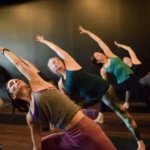
Step one foot back about 60 to 80 cm. Turn the back foot out 45 degrees. Bend the front knee over the ankle. Raise arms forward or overhead. This builds leg strength, improves hip flexibility, and opens the chest and lungs. Modify by holding the back of a chair with one hand for balance.
6. Seated Forward Fold — Chair Version
Sit at the edge of a chair with feet flat on the floor. Inhale to lengthen the spine. Exhale and fold forward, hands resting on your shins or the floor. This stretches the hamstrings and lower back without the challenge of getting onto the floor. Hold 8 to 10 breaths.
7. Legs Up the Wall — Viparita Karani
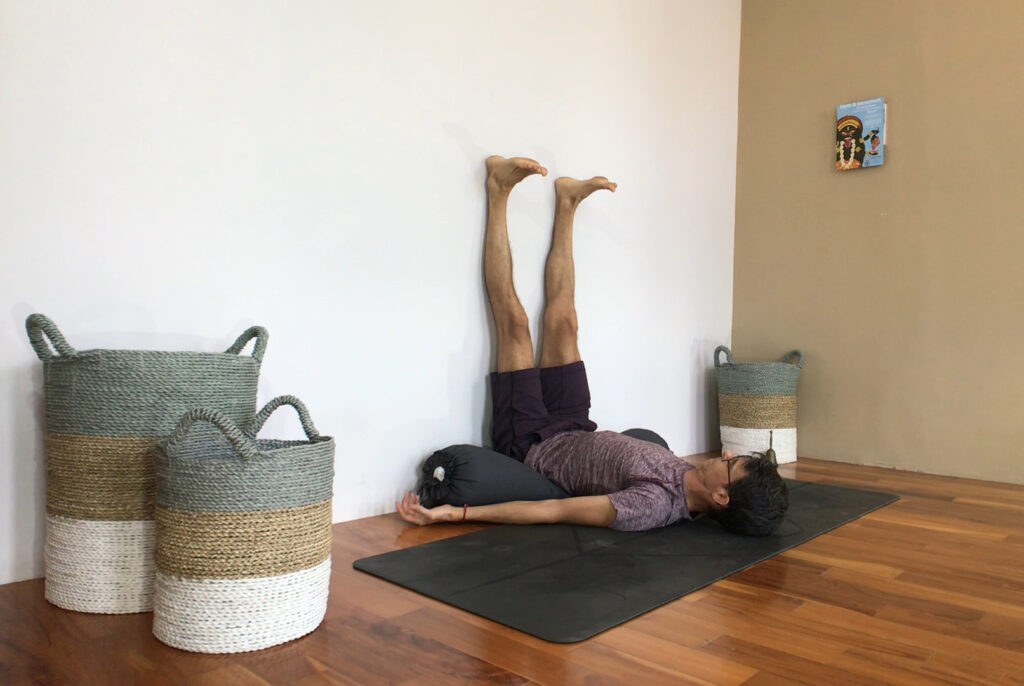
Lie with your legs extended up a wall for 10 to 15 minutes. This gentle inversion reduces leg swelling and varicose vein discomfort, improves circulation, activates the parasympathetic nervous system, and provides the best natural respite for tired legs and lower back. It is one of the most beneficial poses available for seniors and requires virtually no flexibility.
8. Bridge Pose — Setu Bandha Sarvangasana
Lie on your back with knees bent. Press through the feet to lift the hips. Hold 6 to 8 breaths. Bridge pose strengthens the glutes and hamstrings — essential for standing from seated — and gently extends the hip flexors while stimulating the thyroid and adrenal glands. Use a block under the sacrum for the restorative version.
9. Reclined Knee to Chest — Apanasana
Lie on your back. Hug both knees to the chest and rock gently side to side. This is the safest decompression exercise for the lumbar spine and a reliable relief for lower back stiffness. Hold 2 to 3 minutes and use the time to practise slow, deep breathing.
10. Warrior III — Wall-Supported Balance
Stand an arm’s length from a wall. Place your palms flat on the wall at shoulder height. Shift weight onto one foot and hinge forward from the hips, extending the other leg behind you so the body forms an L-shape. This is an advanced balance pose made accessible by the wall, and it is one of the most powerful fall-prevention exercises in existence.
11. Restorative Child’s Pose — With Chair
If kneeling on the floor is uncomfortable, sit in a chair and fold forward, resting your forearms on a table or pillow. This produces the same parasympathetic benefits as the floor version and is equally restorative. Our full guide to Child’s Pose includes all chair and modified variations.
12. Alternate Nostril Breathing — Nadi Shodhana
10 minutes of alternate nostril breathing preserves lung capacity, lowers blood pressure, reduces cortisol, and improves cognitive function — all significant concerns for older adults. For a complete guide to the most beneficial breathing practices, see our resource on breathwork techniques.
Chair Yoga for Seniors: Practising Without Getting on the Floor
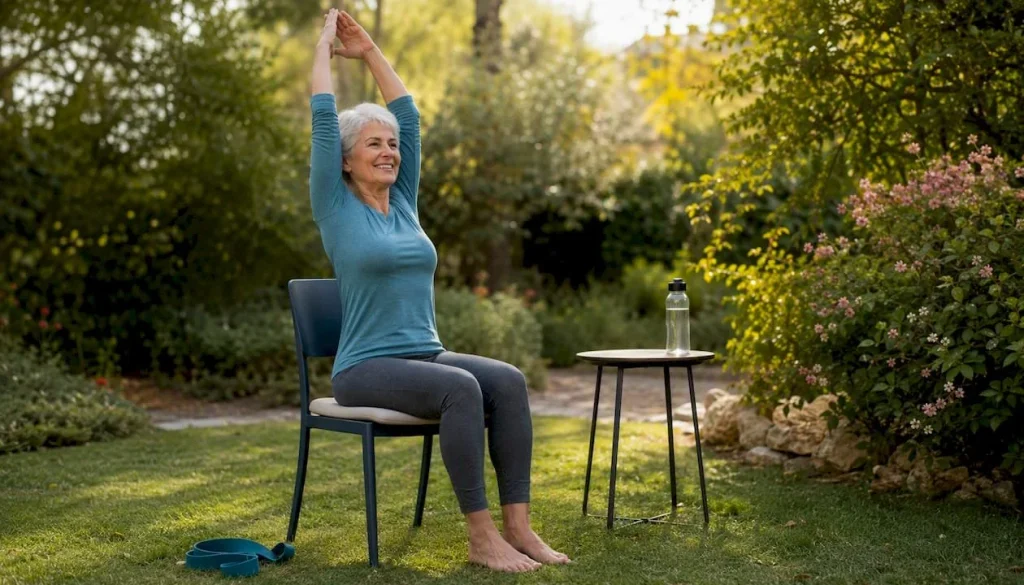
For seniors who cannot safely get onto the floor due to joint replacement, balance issues, or significant mobility limitations, chair yoga provides the full benefits of yoga practice in a completely supported seated position. Every pose described above has a chair adaptation, and there are dozens of additional chair-specific sequences available.
A complete chair yoga session for seniors might include: seated Cat-Cow, seated forward fold, seated twist, seated warrior arms, seated eagle arms, seated leg extensions, seated mountain pose awareness, and a closing breath meditation — all without leaving the chair.
Building a Weekly Yoga Routine for Seniors
- Monday: 30 min gentle standing flow — Mountain, Tree, Warrior I, Cat-Cow, Bridge
- Wednesday: 30 min restorative sequence — Legs Up the Wall, Knee to Chest, Supported Child’s Pose
- Friday: 30 min balance focus — Tree, Warrior III wall, standing balance variations
- Daily: 10 min Nadi Shodhana breathing + 5 min Tadasana awareness
Complement your yoga practice with our guides to yoga for back pain and restorative yoga poses for a comprehensive, well-rounded senior wellness programme.
Discover more expert yoga guides at YogaSniff.com