

Of all the mantras in the vast library of Vedic wisdom, the Gayatri Mantra stands alone.
- The Gayatri Mantra in Sanskrit
- Gayatri Mantra Meaning: Word by Word
- The Complete Gayatri Mantra Meaning in English
- The Three Levels of Gayatri Mantra Meaning
- Benefits of Chanting the Gayatri Mantra
- How to Chant the Gayatri Mantra: Step-by-Step Guide
- Gayatri Mantra and Your Yoga Practice
- Frequently Asked Questions About the Gayatri Mantra
- Final Thoughts: The Light Within the Words
- Explore More on YogaSniff
It is considered the most sacred verse in the entire Rigveda — the oldest of the four Vedas, composed over 3,500 years ago. Hindu tradition holds that the Gayatri Mantra contains within it the essence of all Vedic knowledge. Sages and scholars across millennia have described it as the mother of all mantras — a single verse that contains the seed of universal truth.
But what does the Gayatri Mantra actually mean?
In this complete guide, you will discover the word-by-word meaning of every syllable of the Gayatri Mantra, its profound spiritual significance, its scientifically studied benefits, the correct way to pronounce and chant it, and how this ancient mantra can transform your yoga and meditation practice.

The Gayatri Mantra in Sanskrit
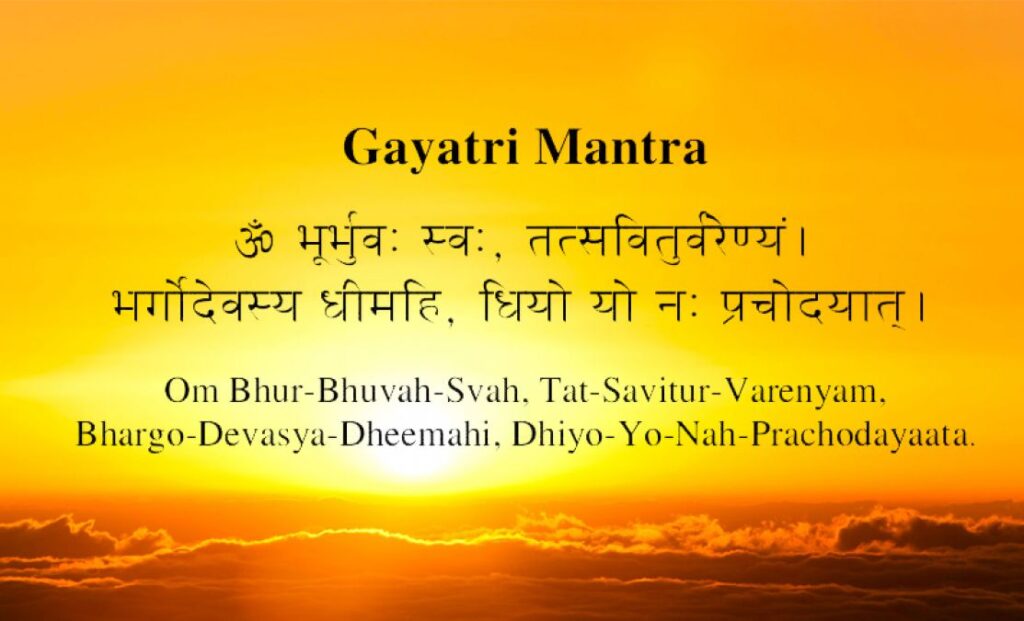
First, let us look at the mantra in its original Sanskrit form:
ॐ भूर्भुवः स्वः तत्सवितुर्वरेण्यं भर्गो देवस्य धीमहि धियो यो नः प्रचोदयात्॥

In transliteration (Roman script):
Om Bhur Bhuva Swaha Tat Savitur Varenyam Bhargo Devasya Dhimahi Dhiyo Yo Nah Prachodayat
Read it aloud slowly. Even before you understand each word, notice how the sounds feel in your body — the vibration of “Om,” the opening of “Bhuva,” the resonance of “Dhimahi.” This is not accidental. The Gayatri Mantra was composed with precise sonic architecture designed to activate specific energy centers in the body and mind.
Gayatri Mantra Meaning: Word by Word
This is the heart of this guide — the complete, word-by-word breakdown of every syllable of the Gayatri Mantra. Understanding each component transforms the mantra from a memorized phrase into a living prayer.

ॐ — Om (or Aum)
Meaning: The primordial sound of the universe — the vibration from which all creation emerged and into which all creation dissolves.
Om is not a word in the conventional sense. It is a sonic symbol of ultimate reality — of Brahman, the universal consciousness that underlies all existence. In yogic tradition, Om is the first and last sound, the sound of the universe breathing.
When you chant Om, you are not worshipping a deity or invoking an external power. You are aligning your individual consciousness with universal consciousness — recognizing that you are not separate from the whole, but a wave in the ocean of being.
In the context of the Gayatri Mantra, Om serves as the opening invocation — an energetic doorway that prepares body, mind, and spirit to receive the mantra’s full power.
ॐ भूः — Om Bhuh
Meaning: The physical world; the earth plane; the realm of the physical body
Bhuh refers to the material dimension of existence — everything that can be perceived through the five physical senses. It is the world of form, matter, and the physical body. In the chakra system, Bhuh connects to the root chakra (Muladhara) — the foundation of physical existence.
भुवः — Bhuva (Bhuvah)
Meaning: The astral or intermediate world; the realm of the breath, mind, and life force (Prana)
Bhuva refers to the energetic or astral dimension — the realm between the purely physical and the purely spiritual. It encompasses the breath, the mind, and the life force (Prana) that animates the physical body. This is the realm of dreams, emotions, and the subtle energy body that yogic tradition maps through the nadis and chakras.
स्वः — Swaha (Svah)
Meaning: The celestial world; the realm of the spirit and higher consciousness
Swaha refers to the highest of the three worlds — the spiritual dimension, the realm of pure consciousness, divine intelligence, and cosmic light. Together, Bhuh-Bhuva-Swaha represent the three planes of existence: physical, astral, and spiritual — the complete cosmos.
This three-part invocation at the opening of the Gayatri Mantra is called the Mahavyahritis — the Great Utterances. By chanting them, the practitioner acknowledges and honors all three dimensions of reality simultaneously.
तत् — Tat
Meaning: That; the Absolute; the Divine
Tat is a Sanskrit pronoun pointing to the divine — to ultimate reality that transcends all names, forms, and descriptions. It is the same “Tat” in the great Vedantic declaration “Tat tvam asi” — “That thou art” — meaning you yourself are the divine, not separate from it.
सवितुर् — Savitur
Meaning: Of the sun; of Savitr — the solar deity representing the divine light that illuminates all
Savitur comes from the root “su” — to generate, to create, to activate. It refers to Savitr, the Vedic solar deity who represents the divine creative intelligence expressed through the light and energy of the sun. Importantly, Savitr does not refer only to the physical sun in the sky but to the inner spiritual sun — the light of consciousness and wisdom that illuminates the mind from within.
वरेण्यं — Varenyam
Meaning: Most worthy of worship; most excellent; deserving of reverence; the most adorable
Varenyam comes from the Sanskrit root meaning “to choose” or “to desire.” It describes divine light as the most worthy, most excellent, most desirable thing that exists — the highest that the human spirit can aspire toward and attain.
भर्गो — Bhargo
Meaning: The radiant light; the divine effulgence; the brilliance that burns away darkness and ignorance
Bhargo is one of the most powerful words in the entire mantra. It refers to a specific quality of divine light — not ordinary light, but the burning, purifying, illuminating light of divine consciousness that destroys ignorance, ego, and delusion at their root.
This word is central to the mantra’s transformative power. The Gayatri Mantra is fundamentally a prayer for this light — the inner light of wisdom and consciousness — to illuminate the mind.
देवस्य — Devasya
Meaning: Of the divine; of God; of the shining one
Devasya is the possessive form of “Deva” — meaning “the shining one” or “the divine.” In Vedic tradition, devas are not external supernatural beings but expressions of the one divine consciousness manifesting in different forms and qualities throughout creation.
धीमहि — Dhimahi
Meaning: We meditate upon; we contemplate; we absorb ourselves in
Dhimahi comes from the Sanskrit root “dhi” — meaning intellect, understanding, and meditation. This verb is the active heart of the mantra’s meaning — it describes what the practitioner is doing: deeply meditating upon, contemplating, and absorbing the divine light described in the preceding words.
This is not passive observation but active, intentional immersion in divine light.
धियो — Dhiyo
Meaning: Our intellect; our understanding; our power of discernment and wisdom
Dhiyo refers specifically to “dhi” — the higher intellect or wisdom faculty. Not the analytical, logical mind (manas) but the deeper faculty of intuitive wisdom and right understanding (buddhi). This is the faculty through which we discern truth from illusion, reality from appearance.
यो — Yo
Meaning: Who; that which; the one who
A simple relative pronoun — connecting the divine light being described to the action being requested.
नः — Nah
Meaning: Our; ours; of us
This makes the mantra communal rather than individual. The Gayatri Mantra is not a personal prayer for one person’s enlightenment — it is a prayer for the illumination of all beings. “Nah” shifts it from “my intellect” to “our intellect” — a prayer for the awakening of humanity.
प्रचोदयात् — Prachodayat
Meaning: May it inspire; may it guide; may it impel us forward; may it illuminate and direct
Prachodayat is the final and most action-oriented word of the mantra. It is a verb in the optative mood — expressing a wish, a prayer, an aspiration. It means: may that divine light actively guide, inspire, awaken, and impel our intellect toward truth.
The Complete Gayatri Mantra Meaning in English
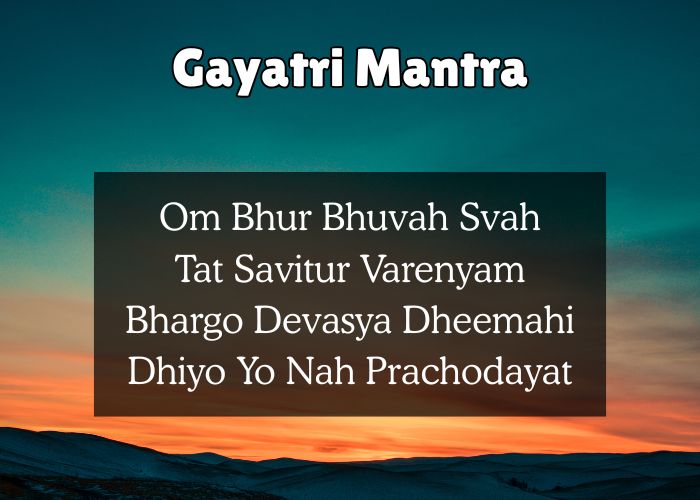
Bringing all of these words together, here is the complete meaning of the Gayatri Mantra:
“Om. We meditate upon the divine light of that adorable sun of spiritual consciousness. May that divine light illuminate our intellect and inspire us toward truth.”
Or in an even more expanded rendering:
“Om. We invoke the three planes of existence — the physical, the astral, and the spiritual. We meditate upon the glorious, radiant, divine light of the solar consciousness — that most adorable, most worthy, most excellent divine effulgence that burns away all darkness and ignorance. May that divine light awaken, guide, and inspire our intellect and understanding toward the highest truth.”
Every time you chant the Gayatri Mantra, you are not performing a ritual. You are actively meditating on divine light, consciously inviting that light to enter your mind and illuminate your understanding. You are participating in one of humanity’s oldest and most powerful spiritual practices.
The Three Levels of Gayatri Mantra Meaning
The Gayatri Mantra operates simultaneously on three levels — and this is what makes it uniquely powerful among all mantras.
Level 1: The Cosmic Level
At the cosmic level, the mantra is a meditation on the light of universal consciousness — the divine intelligence that creates, sustains, and pervades all of existence. Chanting it aligns your individual awareness with this cosmic reality.
Level 2: The Solar Level
At the solar level, the mantra is a meditation on the physical and spiritual sun — the source of all life, light, and energy on earth. In Vedic tradition, the sun is not just a star but a living spiritual being whose light carries divine intelligence. The Gayatri Mantra is traditionally chanted facing the sun at sunrise, noon, and sunset precisely to align with this solar energy.
Level 3: The Personal Level
At the personal level, the mantra is a deeply practical prayer for the illumination of your own mind. “May that light guide my intellect” — this is a prayer for clarity, wisdom, right perception, and the ability to distinguish truth from illusion in your own daily life.
Benefits of Chanting the Gayatri Mantra
The Gayatri Mantra has been studied in both traditional spiritual contexts and contemporary research settings. Here are the well-documented benefits of regular practice:
Mental and Cognitive Benefits
Improved concentration and focus. The rhythmic repetition of the mantra trains the mind to sustain single-pointed attention — the same quality cultivated in meditation and yoga. Regular practitioners typically report enhanced ability to focus and reduced mental scatter.
Reduced anxiety and stress. Multiple studies on mantra chanting have shown measurable reductions in cortisol (the primary stress hormone) and activation of the parasympathetic nervous system — the “rest and digest” response. The specific sound frequencies of the Gayatri Mantra appear particularly effective in producing this calming neurological response.
Enhanced memory and learning. The chanting of Sanskrit mantras has been associated in traditional texts and some contemporary research with improvements in memory, pattern recognition, and cognitive flexibility.
Physical Benefits
Nervous system regulation. The controlled breathing required to chant the mantra — particularly when chanted slowly with full breath — directly regulates the autonomic nervous system, reducing the impact of chronic stress on the body.
Throat and vocal health. Regular chanting strengthens the vocal cords, the diaphragm, and the respiratory muscles. It also directly activates and clears the throat chakra (Vishuddha), benefiting communication and authentic self-expression.
Heart rate variability. The slow, rhythmic breathing of mantra chanting has been shown to improve heart rate variability — a key marker of cardiovascular health and overall resilience.
Spiritual and Energetic Benefits
Chakra activation. The vibrations of the Gayatri Mantra resonate through all seven chakras simultaneously. Traditional teaching holds that regular chanting progressively opens and purifies the entire chakra system.
Aura brightening. In energy healing traditions, regular mantra practice — particularly of the Gayatri — gradually raises the vibrational frequency of the practitioner’s aura, shifting it toward the higher-spectrum colors (blue, indigo, violet).
Spiritual protection. The Gayatri Mantra is considered in Hindu and yogic tradition to be one of the most powerful forms of spiritual protection available. The light it invokes is understood to naturally repel lower vibrational energies.
How to Chant the Gayatri Mantra: Step-by-Step Guide
Step 1: Choose Your Time
The Gayatri Mantra is traditionally chanted during the three Sandhya periods — the transitional moments of the day:
- Dawn (Brahma Muhurta): The hour before and after sunrise — considered the most auspicious time
- Noon: When the sun is at its zenith
- Dusk: As the sun sets
If you cannot chant at these times, any time of sincere practice has value. Morning practice, ideally before or during sunrise, is most recommended for beginners.
Step 2: Prepare Your Space and Body
Sit comfortably in a cross-legged position (Sukhasana or Padmasana) or on a chair with your spine tall and feet flat on the floor. Face east if possible — toward the rising sun.
Take three slow, deep breaths to settle your mind and body. If possible, wash your hands and face before beginning — a simple act of physical purification that mirrors the internal purification the mantra creates.
Step 3: Begin with Om
Always begin with a long, resonant chant of Om alone. Allow the sound to fully vibrate in your chest, throat, and head before proceeding into the full mantra.
Step 4: Chant the Full Mantra
Chant the complete mantra slowly and deliberately:
Om Bhur Bhuva Swaha Tat Savitur Varenyam Bhargo Devasya Dhimahi Dhiyo Yo Nah Prachodayat
As you chant, keep your awareness focused on the meaning — on the image of divine light entering and illuminating your mind. Do not let the chanting become mechanical repetition. Each word is a meditation.
Step 5: Set Your Repetitions
Traditional practice recommends chanting the Gayatri Mantra in multiples of 3:
- 3 repetitions — minimum for a short daily practice
- 9 repetitions — standard daily practice
- 108 repetitions — full mala practice; deeply transformative
Use a mala (prayer beads with 108 beads) to count repetitions without engaging the analytical mind.
Step 6: Close Your Practice
After your final repetition, sit in silence for at least 1–2 minutes. Allow the vibration of the mantra to settle into your body and energy field. This silent integration period is as important as the chanting itself.
Gayatri Mantra and Your Yoga Practice
The Gayatri Mantra and yoga are natural companions — both are ancient Vedic practices designed to unite individual consciousness with universal consciousness.
Here are specific ways to integrate the Gayatri Mantra into your yoga practice:
Opening invocation. Begin every yoga session by chanting the Gayatri Mantra three times. This shifts your practice from physical exercise into conscious spiritual discipline and sets a clear, elevated intention for everything that follows.
Sun Salutation (Surya Namaskar) mantra. The Gayatri Mantra is the perfect companion to Surya Namaskar — both honor the solar energy. Chant or mentally recite the mantra as you move through each sun salutation, syncing breath, movement, and sacred sound.
Savasana meditation. As you rest in Savasana at the end of practice, mentally repeat the Gayatri Mantra in coordination with your breath. This deepens the integration of your physical practice into your energetic and spiritual body.
Pranayama combination. Chanting the Gayatri Mantra in coordination with Nadi Shodhana (alternate nostril breathing) is a particularly powerful combination for balancing the nervous system and activating the third eye.
Frequently Asked Questions About the Gayatri Mantra
What is the simple meaning of the Gayatri Mantra?
Simply stated, the Gayatri Mantra means: “We meditate upon the divine, radiant light of the sun of spiritual consciousness. May that divine light illuminate and guide our intellect.” It is a prayer for wisdom, clarity, and inner illumination — one of the most universal prayers in human spiritual history.
Who wrote the Gayatri Mantra?
The Gayatri Mantra is attributed to the sage Vishwamitra, who received it as divine revelation and composed it in the Rigveda (Mandala 3, hymn 62, verse 10). It is approximately 3,500 years old, though many traditions hold its origins to be even more ancient.
Can anyone chant the Gayatri Mantra?
Yes. While in some traditional lineages the Gayatri Mantra was historically restricted to certain castes or genders, the overwhelming consensus of modern spiritual teachers — including many respected traditional Vedic scholars — is that the Gayatri Mantra belongs to all humanity. Its light and its benefits are available to any sincere practitioner regardless of background, religion, or tradition.
How many times should I chant the Gayatri Mantra?
Traditional practice recommends a minimum of 3 repetitions for a short daily practice, 9 for a standard practice, and 108 (one full mala) for deep transformative work. The most important factor is not quantity but sincerity — chanting with full awareness and understanding of the meaning is infinitely more valuable than mechanical repetition.
What is the best time to chant the Gayatri Mantra?
Dawn — the hour around sunrise — is universally considered the most auspicious time to chant the Gayatri Mantra. The energy of the rising sun and the quiet of early morning create ideal conditions for the mantra’s power to work most effectively. The Sanskrit term for this pre-dawn period is Brahma Muhurta — the hour of Brahma.
Can the Gayatri Mantra be chanted silently?
Yes. The Gayatri Mantra can be chanted aloud (Vaikhari), whispered (Upamshu), or mentally (Manasika). Traditional teaching holds that mental chanting is actually the most powerful form, as it requires the greatest level of concentration and creates the deepest impact on the subtle mind. That said, audible chanting creates physical vibration in the body that has its own significant benefits.
What does Om Bhur Bhuva Swaha mean?
Om Bhur Bhuva Swaha are the Mahavyahritis — the three great utterances. Bhur means the physical world, Bhuva means the astral or energetic realm, and Swaha means the spiritual or celestial world. Together, they represent the three planes of existence — the totality of the cosmos — and serve as an opening invocation acknowledging all dimensions of reality.
Final Thoughts: The Light Within the Words
The Gayatri Mantra has survived for over three thousand years not because of tradition or habit, but because it works.
Every sincere practitioner who has chanted this mantra daily for months or years reports the same thing: a gradual but unmistakable brightening of the mind. A growing capacity to see clearly — to perceive situations with wisdom rather than reactivity, to make choices from inner light rather than fear or desire.
This is what the mantra promises. And this is what it delivers.
Whether you are a lifelong yoga practitioner or someone encountering this mantra for the very first time, the invitation is the same: begin. Even three sincere repetitions each morning, with full awareness of the meaning, will begin to transform your inner world in ways that no amount of reading about the Gayatri Mantra can.
The light is already there within you. The Gayatri Mantra simply helps you remember it.