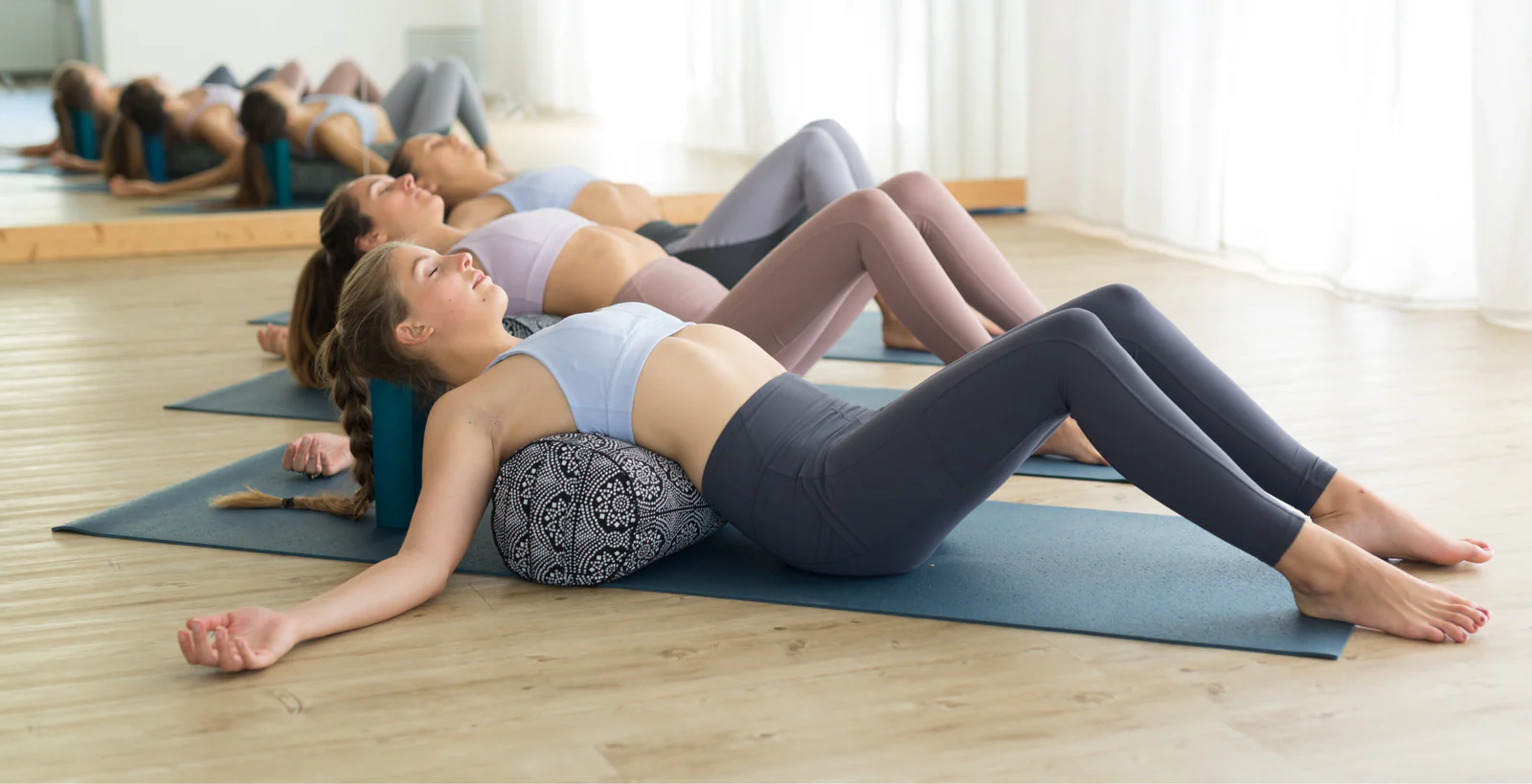
Are you constantly exhausted, mentally drained, and feeling like your body never truly gets the rest it needs? You’re not alone. In today’s hyper-connected world of 2026, chronic stress affects over 77% of adults regularly, according to the American Institute of Stress. While high-intensity workouts dominate social media feeds, there’s a powerful antidote that’s gaining recognition: restorative yoga poses.
Unlike traditional yoga that builds strength and flexibility, restorative yoga is designed specifically for deep relaxation and healing. These gentle, supported postures allow your nervous system to shift from fight-or-flight mode into rest-and-digest, triggering profound physical and mental restoration.
In this comprehensive guide, you’ll discover the 15 most effective restorative yoga poses, learn how to practice them correctly, understand their healing benefits, and create a personalized practice that transforms your stress levels. Whether you’re recovering from injury, battling burnout, or simply seeking better sleep, these poses offer a scientifically-backed path to genuine rest.
QUICK ANSWER BOX
What are restorative yoga poses?
- Gentle, supported postures held for 5-20 minutes using props like bolsters, blankets, and blocks
- Designed to activate the parasympathetic nervous system for deep relaxation
- Focus on passive stretching rather than active muscle engagement
- Ideal for stress relief, injury recovery, and improving sleep quality
- Suitable for all ages and fitness levels, including complete beginners
TABLE OF CONTENTS
- What Is Restorative Yoga and Why It Works
- The Science-Backed Benefits of Restorative Yoga Poses
- Essential Props for Practicing Restorative Yoga
- 15 Powerful Restorative Yoga Poses for Deep Healing
- How to Create Your Restorative Yoga Practice
- Common Mistakes to Avoid
- FAQ: Your Restorative Yoga Questions Answered
What Is Restorative Yoga and Why It Works
Restorative yoga is a therapeutic style of yoga developed in the 1970s by B.K.S. Iyengar and later refined by Judith Hanson Lasater. Unlike vinyasa or power yoga, restorative poses are entirely passive. You’re fully supported by props, allowing complete muscular relaxation.
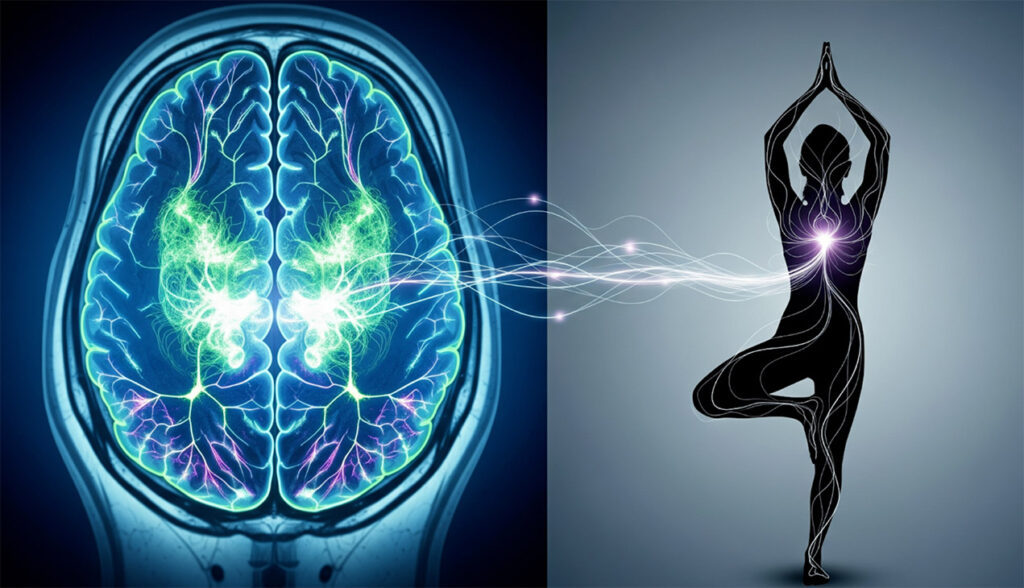
The magic happens in the stillness. When you hold supported poses for extended periods (typically 5-20 minutes), your body receives clear signals that it’s safe to relax. This triggers the parasympathetic nervous system—your body’s natural relaxation response.
How Restorative Yoga Differs from Other Styles
Traditional yoga styles focus on building strength, flexibility, and endurance. They’re active practices where you work against gravity and engage muscles. Restorative yoga poses flip this approach entirely.
In restorative practice, gravity works with you, not against you. Props provide complete support so muscles can release tension they’ve been holding, sometimes for years. This creates space for deep healing that active stretching simply cannot achieve.
According to a 2024 study published in the Journal of Clinical Psychology, participants who practiced restorative yoga for 8 weeks showed a 42% reduction in cortisol levels compared to those who practiced vigorous yoga styles.
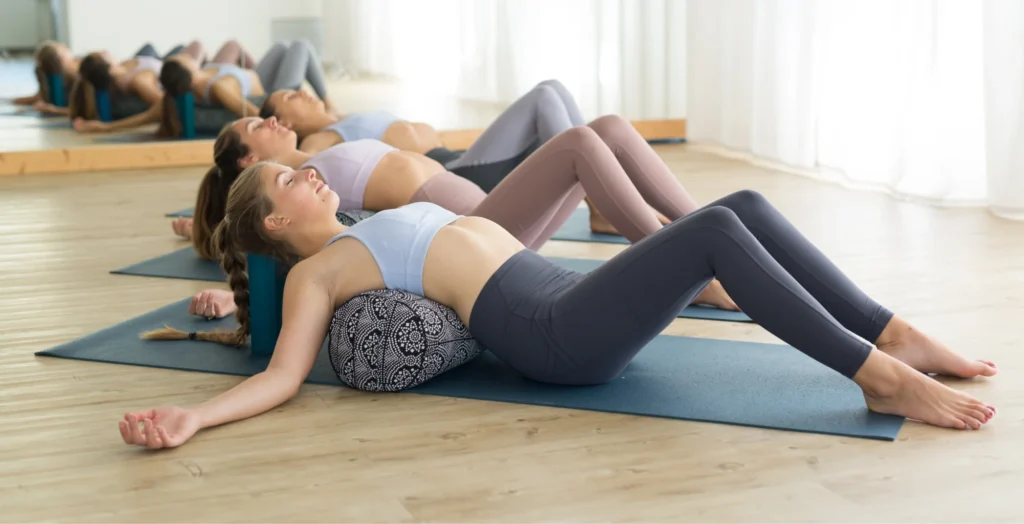
The Science-Backed Benefits of Restorative Yoga Poses
Physical Health Benefits
Improved Sleep Quality Research from Stanford University’s 2025 sleep study found that individuals practicing restorative yoga poses before bed fell asleep 35% faster and experienced 28% fewer nighttime awakenings. The gentle stretches release physical tension while calming the mind.
Reduced Chronic Pain Restorative yoga poses are particularly effective for managing chronic pain conditions. A 2024 meta-analysis in Pain Medicine Journal reviewed 23 studies and concluded that restorative yoga reduced pain intensity by an average of 31% across conditions including fibromyalgia, lower back pain, and arthritis.
Enhanced Injury Recovery Physical therapists increasingly recommend gentle restorative poses for injury rehabilitation. The supported positions allow healing tissues to receive increased blood flow without stress, accelerating recovery while preventing re-injury.
Mental and Emotional Benefits
Stress and Anxiety Reduction As of 2026, the American Psychological Association recognizes restorative yoga as an evidence-based complementary treatment for anxiety disorders. The practice reduces stress hormones while increasing GABA, a neurotransmitter that promotes calmness.
Improved Emotional Regulation When you spend time in supported, comfortable positions, you create space to process emotions without being overwhelmed by them. Many practitioners report improved emotional resilience after consistent practice.
Better Focus and Mental Clarity By giving your nervous system permission to rest completely, restorative yoga poses improve cognitive function. Recent studies show enhanced focus, memory, and decision-making abilities following regular practice.
Essential Props for Practicing Restorative Yoga
Restorative yoga poses require proper support to achieve full relaxation. While you can improvise with household items, investing in quality props significantly enhances your practice.
Must-Have Props
Yoga Bolsters The cornerstone of restorative practice. Rectangular bolsters provide firm support for the torso, while round bolsters work well for gentle backbends. Budget-friendly option: Use firm couch cushions or rolled blankets.
Yoga Blocks These provide elevation and support for various poses. Cork blocks are eco-friendly and sturdy, while foam blocks are lighter and softer. Household alternative: Thick hardcover books wrapped in towels.
Blankets (2-4) Mexican blankets or yoga blankets add cushioning, warmth, and height adjustment. They’re incredibly versatile. Use any firm blankets you have at home—avoid fluffy ones that compress too much.
Eye Pillow Weighted eye pillows block light and provide gentle pressure that calms the nervous system. DIY version: Fill a soft sock with rice and lavender.
Yoga Strap Helps maintain gentle stretches without effort. A belt or bathrobe tie works perfectly as a substitute.
Optional But Beneficial Props
Sandbags add grounding weight, meditation cushions support seated positions, and a yoga mat provides grip and defines your practice space.
15 Powerful Restorative Yoga Poses for Deep Healing
1. Supported Child’s Pose (Balasana)
Benefits: Gently stretches the hips, thighs, and ankles while calming the mind and relieving stress.
How to Practice:
- Place a bolster lengthwise between your knees
- Fold forward, resting your torso completely on the bolster
- Turn your head to one side, switching halfway through
- Arms can rest alongside the bolster or extend forward
- Hold for 5-10 minutes
Modification: Add blankets under your knees or elevate the bolster if you feel any strain.
2. Supported Reclining Bound Angle Pose (Supta Baddha Konasana)
Benefits: Opens the hips and chest, improves circulation, reduces anxiety, and supports reproductive health.
How to Practice:
- Sit with a bolster behind you running along your spine
- Bring soles of feet together, knees falling open
- Recline back onto the bolster, supporting your head
- Place blocks or blankets under each knee for support
- Rest arms at sides, palms up
- Hold for 10-15 minutes
This is one of the most beloved restorative yoga poses for its profound calming effects.
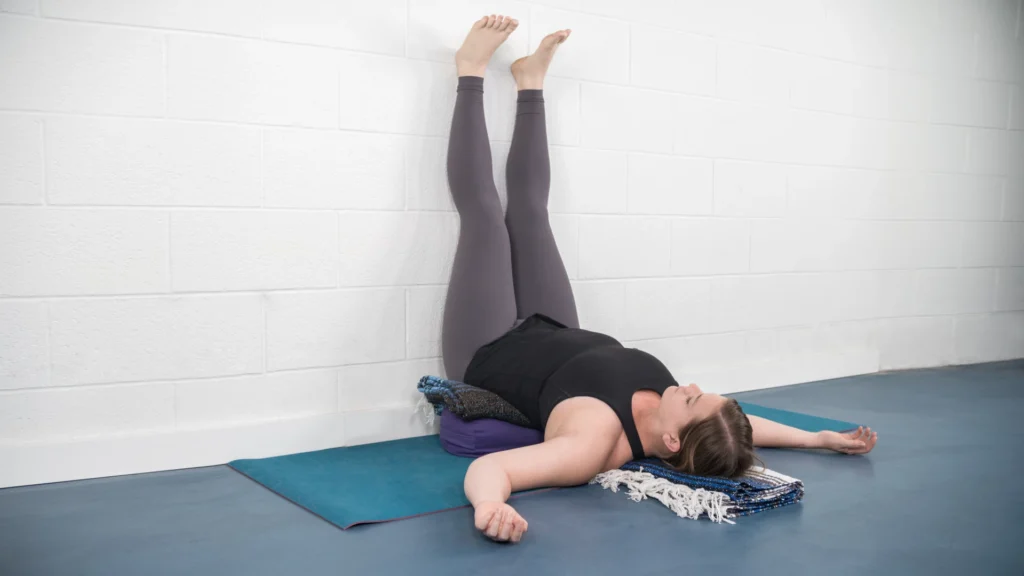
3. Legs-Up-The-Wall Pose (Viparita Karani)
Benefits: Reduces swelling in legs and feet, calms anxiety, improves circulation, and may help regulate blood pressure.
How to Practice:
- Sit sideways against a wall
- Swing your legs up the wall as you lower your back to the floor
- Hips can be touching the wall or a few inches away
- Place a folded blanket under your hips for gentle elevation
- Arms rest at sides, palms up
- Hold for 10-20 minutes
A 2025 study found this pose reduced perceived stress by 38% when practiced daily for just 15 minutes.
4. Supported Bridge Pose (Setu Bandha Sarvangasana)
Benefits: Gently opens the chest and shoulders, stretches the spine, and can relieve lower back discomfort.
How to Practice:
- Lie on your back, knees bent, feet flat on floor
- Lift hips and slide a block or bolster underneath your sacrum
- Adjust the height for comfort (block has three height options)
- Let your weight rest completely on the support
- Arms rest alongside body
- Hold for 5-10 minutes
5. Supported Forward Fold (Paschimottanasana)
Benefits: Calms the nervous system, stretches the spine and hamstrings gently, improves digestion.
How to Practice:
- Sit with legs extended, bolster across thighs
- Fold forward, resting torso on the bolster
- Turn head to one side, switch halfway
- Keep knees slightly bent if hamstrings are tight
- Hold for 5-10 minutes
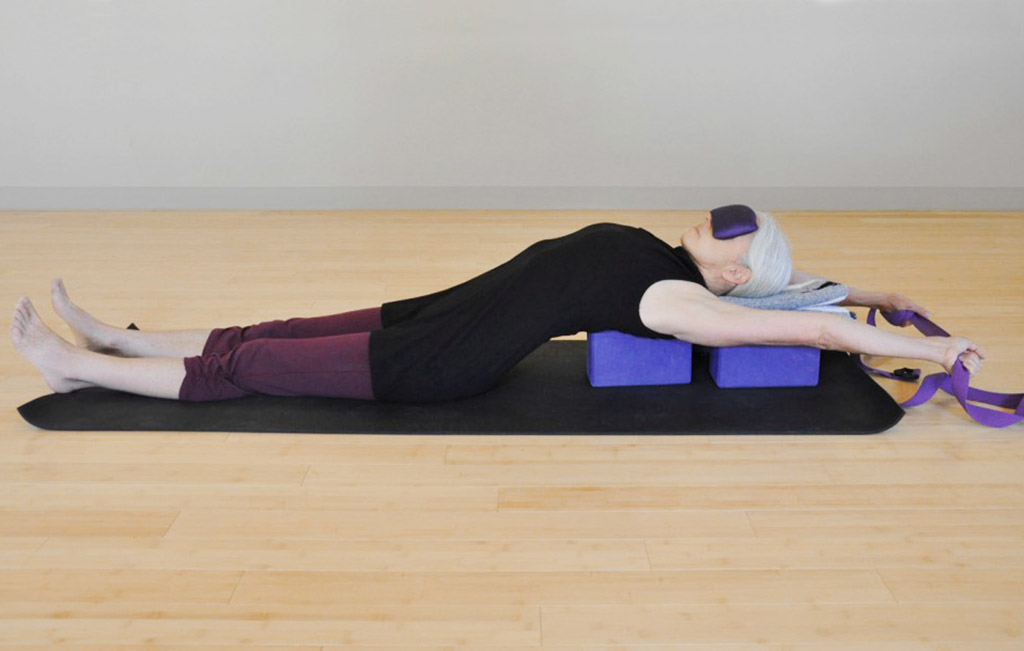
6. Supported Fish Pose (Matsyasana)
Benefits: Opens the chest and throat, improves breathing capacity, counters rounded-shoulder posture.
How to Practice:
- Place a block under your upper back (between shoulder blades)
- Another block supports your head at a comfortable height
- Legs can be extended or in bound angle position
- Arms rest at sides or overhead
- Hold for 5-10 minutes
7. Supported Spinal Twist (Jathara Parivartanasana)
Benefits: Aids digestion, releases tension in the spine, massages internal organs.
How to Practice:
- Lie on your back, hug knees to chest
- Let both knees fall to the right, place a bolster under them
- Extend arms in a T-position
- Turn head to the left (opposite of knees)
- Hold for 5-8 minutes, then switch sides
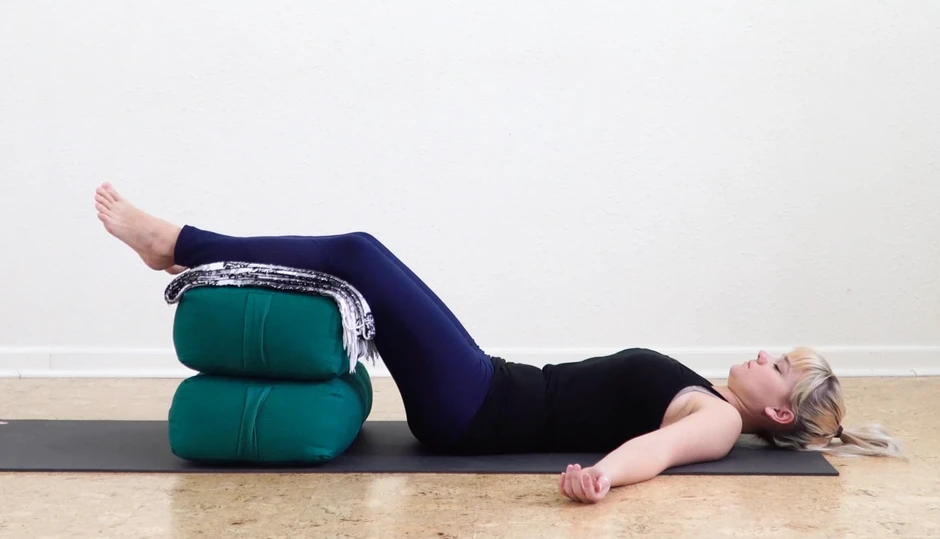
8. Supported Savasana (Corpse Pose)
Benefits: Complete relaxation, integration of practice, stress relief, improved sleep quality.
How to Practice:
- Lie flat on your back
- Place a bolster under your knees to release lower back
- Small rolled blanket or towel under your neck
- Eye pillow over closed eyes
- Blanket over body for warmth
- Hold for 10-20 minutes
This ultimate relaxation pose is where the deepest healing occurs.
9. Supported Side-Lying Pose
Benefits: Ideal for pregnancy, digestive issues, or when lying on your back is uncomfortable.
How to Practice:
- Lie on your left side
- Place a bolster under your head and neck
- Another bolster between your knees
- Top arm rests on a folded blanket in front of you
- Hold for 10-15 minutes, can switch sides
10. Supported Seated Forward Fold
Benefits: Calms anxiety, gently stretches the back body, accessible for those with tight hamstrings.
How to Practice:
- Sit in a chair or on the edge of your bed
- Stack pillows or a bolster on your lap
- Fold forward, resting your torso on the support
- Let arms drape down
- Hold for 5-8 minutes
11. Supported Heart Opener
Benefits: Counteracts hunched posture, opens chest and shoulders, improves breathing.
How to Practice:
- Roll two blankets into firm cylinders
- Lie back with one roll along your spine, another under knees
- Arms rest in a T-position or cactus shape
- Let chest gently open
- Hold for 8-12 minutes
12. Supported Pigeon Pose (Eka Pada Rajakapotasana)
Benefits: Deep hip release, relieves sciatic discomfort, releases emotional tension stored in hips.
How to Practice:
- Come into pigeon pose with right leg forward
- Stack blankets or a bolster under your right hip for support
- Fold forward, resting on a bolster placed in front of you
- Hold for 5-8 minutes per side
13. Supported Goddess Pose (Supta Baddha Konasana Variation)
Benefits: Opens hips and groin, supports pelvic floor health, deeply grounding.
How to Practice:
- Lie on back with feet together, knees open
- Strap around lower back, across feet, creating a loop
- Bolster under spine, blocks under knees
- Arms rest overhead or at sides
- Hold for 10-15 minutes
14. Supported Seated Meditation Pose
Benefits: Promotes mental clarity, supports meditation practice, reduces knee and hip strain.
How to Practice:
- Sit cross-legged on folded blankets (hips higher than knees)
- Back against a wall or bolster for support
- Hands rest on knees or in lap
- Maintain gentle upright posture without strain
- Hold for 10-20 minutes
15. Supported Happy Baby Pose (Ananda Balasana)
Benefits: Releases lower back and hips, calming, playful energy.
How to Practice:
- Lie on back, knees bent toward chest
- Hold outer edges of feet or use a strap
- Let gravity gently pull knees toward armpits
- Place folded blankets under head for comfort
- Hold for 5-8 minutes
How to Create Your Restorative Yoga Practice
For Beginners: 20-Minute Evening Sequence
Start with just 3-4 restorative yoga poses held for 5 minutes each:
- Supported Child’s Pose (5 minutes)
- Legs-Up-The-Wall (8 minutes)
- Supported Reclining Bound Angle (5 minutes)
- Supported Savasana (5 minutes)
Practice this sequence nightly for two weeks before expanding.
For Intermediate Practitioners: 45-Minute Full Practice
Include 6-7 poses with longer hold times:
- Supported Forward Fold (7 minutes)
- Supported Bridge (6 minutes)
- Supported Spinal Twist (6 minutes each side)
- Supported Fish (8 minutes)
- Legs-Up-The-Wall (10 minutes)
- Supported Savasana (10 minutes)
Best Time to Practice
Evening (7-9 PM): Ideal for unwinding after work, preparing for sleep. The most popular time for restorative practice.
Morning (6-8 AM): Gentle wake-up, setting a calm tone for the day. Use slightly shorter hold times.
Midday (12-2 PM): Perfect stress reset during work breaks. Even 15 minutes provides significant benefits.
Creating the Right Environment
Temperature: Keep your space warm (70-75°F). Your body temperature drops during deep relaxation, so have a blanket nearby.
Lighting: Dim lights or use candlelight. Harsh lighting prevents full relaxation.
Sound: Silence, nature sounds, or soft instrumental music. Avoid lyrics that engage the thinking mind.
Aromatherapy: Lavender, chamomile, or sandalwood essential oils enhance relaxation when used sparingly.
Common Mistakes to Avoid in Restorative Yoga
Rushing the Setup
The most common error is not taking enough time to get fully comfortable. Spend 2-3 minutes adjusting props for each pose. If something feels slightly uncomfortable in the first minute, it will be unbearable by minute ten.
Using Too Few Props
More support equals deeper relaxation. Don’t try to “tough it out” with minimal props. This defeats the entire purpose of restorative yoga poses.
Not Staying Long Enough
Your nervous system needs time to shift gears. Holding poses for less than 5 minutes limits the therapeutic benefits. As of 2026, research suggests 7-10 minutes per pose optimizes relaxation response.
Checking Your Phone
Looking at screens between poses stimulates your nervous system, undoing the benefits. Set a gentle timer and resist the urge to check messages.
Practicing on an Empty or Full Stomach
Practice 1-2 hours after light meals. A full stomach is uncomfortable in many poses, while an empty stomach may cause distraction.
FAQ: Your Restorative Yoga Questions Answered
Q: How often should I practice restorative yoga poses? A: For stress relief and general wellness, practice 2-4 times per week. For injury recovery or chronic conditions, daily practice of 20-30 minutes offers optimal benefits. Even once weekly provides measurable improvements in stress levels and sleep quality.
Q: Can beginners do restorative yoga without prior experience? A: Absolutely! Restorative yoga is ideal for complete beginners because it requires no flexibility, strength, or prior yoga knowledge. The supported nature of the poses makes them accessible to everyone regardless of age or fitness level.
Q: What’s the difference between restorative yoga and yin yoga? A: While both styles hold poses for extended periods, restorative yoga uses maximum props for complete support with zero effort, targeting the nervous system. Yin yoga uses minimal props and creates moderate sensation in connective tissues through gentle stress.
Q: How many restorative yoga poses should I do in one session? A: Quality matters more than quantity. A 30-minute session might include just 3-4 poses, while a 60-minute practice typically includes 5-7 poses. Each pose should be held for at least 5-10 minutes to activate the relaxation response.
Q: Can I practice restorative yoga during pregnancy? A: Yes, restorative yoga poses are generally safe and beneficial during pregnancy with appropriate modifications. Avoid deep twists, poses that compress the belly, and lying flat on your back after the first trimester. Consult your healthcare provider before beginning any new practice.
Q: Will restorative yoga help me lose weight? A: While restorative yoga doesn’t burn many calories directly, it supports weight loss by reducing cortisol (stress hormone linked to belly fat), improving sleep quality, and supporting hormone balance. It pairs excellently with more active exercise for overall wellness.
Q: Do I need a yoga mat for restorative poses? A: A yoga mat provides cushioning and grip but isn’t essential. You can practice on carpet, a rug, or even your bed for some poses. The props matter more than the mat for restorative practice.
Q: Can restorative yoga replace my regular yoga practice? A: Restorative yoga offers different benefits than active yoga styles. Ideally, balance both: active practice builds strength and flexibility, while restorative practice provides recovery and stress relief. Many practitioners do active yoga 3-4x weekly and restorative 2-3x weekly.
Q: How long before I notice benefits from restorative yoga? A: Many people feel immediate relaxation after their first session. For lasting changes in stress levels, sleep quality, and pain management, practice consistently for 3-4 weeks. Research shows significant measurable benefits appear around the 8-week mark.
Q: Can I practice restorative yoga if I have chronic pain? A: Yes, restorative yoga poses are particularly beneficial for chronic pain conditions including fibromyalgia, arthritis, and back pain. Start gently, use ample props, and work with a qualified instructor who understands your condition. Never push into pain.
Q: What should I wear for restorative yoga practice? A: Wear comfortable, loose-fitting clothing that doesn’t restrict breathing or circulation. Layers are ideal since body temperature drops during relaxation. Avoid tight waistbands, underwire bras, or anything that creates pressure points.
Q: Is it normal to fall asleep during restorative yoga? A: While falling asleep occasionally is normal, the goal is conscious relaxation rather than sleep. If you consistently fall asleep, you may be sleep-deprived and should prioritize getting more nighttime rest. Try practicing earlier in the day or shortening hold times slightly.
Q: Can restorative yoga help with anxiety and depression? A: Clinical research from 2024-2025 shows restorative yoga significantly reduces symptoms of anxiety and mild-to-moderate depression. It activates the parasympathetic nervous system, regulates stress hormones, and provides a safe space for emotional processing. It’s an excellent complement to therapy and medical treatment, though not a replacement.
Q: Do I need special props or can I use household items? A: While dedicated yoga props optimize comfort, you can absolutely use household items. Firm couch cushions replace bolsters, books substitute for blocks, and regular blankets work perfectly. The key is firm, stable support that maintains its shape.
Q: What time of day is best for restorative yoga poses? A: Evening practice (1-2 hours before bed) is ideal for improving sleep and unwinding from daily stress. However, morning or midday sessions also provide excellent benefits for starting your day calmly or resetting during stressful workdays. Practice whenever you can be consistent.
Conclusion: Your Journey to Deep Restoration Begins Now
Restorative yoga poses offer something increasingly rare in our fast-paced world: permission to completely rest. In just 20-30 minutes of supported, passive stretching, you can shift your nervous system from chronic stress to deep healing.
The 15 restorative yoga poses in this guide provide a complete toolkit for managing stress, recovering from injury, improving sleep quality, and finding genuine relaxation. Start with just 2-3 poses this week, focusing on proper setup and allowing yourself to stay present in the stillness.
Your next steps:
- Gather your props (or household alternatives)
- Choose 3 poses from this guide that address your specific needs
- Set aside 20 minutes when you won’t be disturbed
- Practice these same 3 poses daily for one week
- Notice how your body and mind respond
Remember, restorative yoga isn’t about achievement or perfection—it’s about receiving. As you develop this practice throughout 2026, you’re investing in your long-term health, resilience, and wellbeing.
For more gentle yoga practices, explore our guides on Yoga Poses for Flexibility and Yoga for Better Sleep. Share your favorite restorative pose in the comments below—we’d love to hear about your experience.